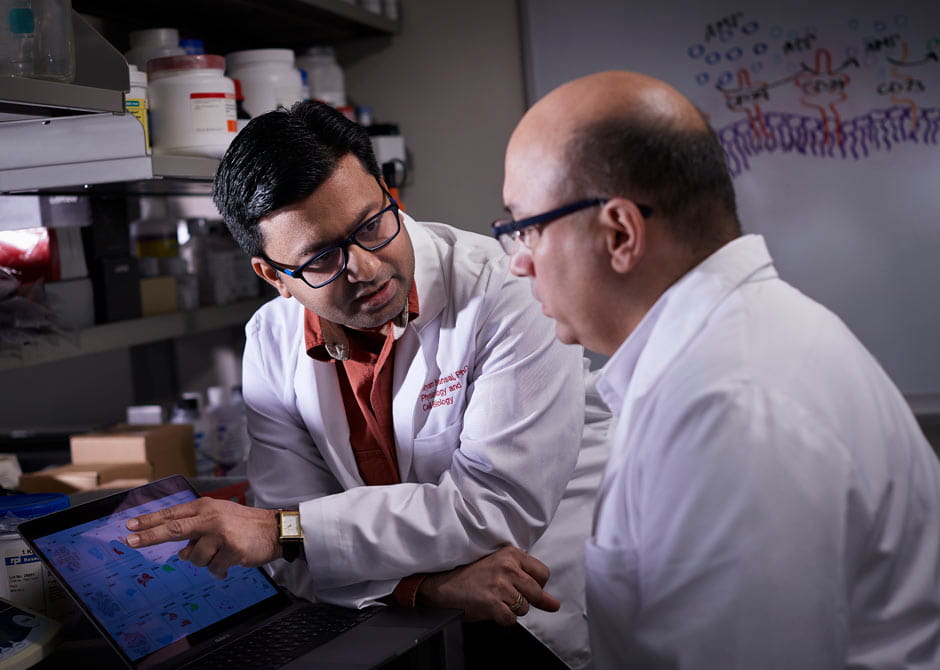
As a pulmonologist in the Division of Pulmonary, Allergy, Critical Care and Sleep Medicine at The Ohio State University's Wexner Medical Center, Dr. Philip Diaz has a primary clinical interest in chronic obstructive pulmonary disease (COPD), which affects more than 12 million adults and is the third leading cause of death in the United States. As a fellow at OSU, he and colleagues discovered a link between a rare form of early-onset COPD and HIV infection, leading to his career in translational research.
COPD is a disease that largely affects smokers, and approximately half of HIV-infected individuals are also smokers. In addition to being concerned about the increasing incidence over time of COPD in people infected with HIV, Diaz is interested in studying COPD in this population as a way to learn more about the molecular basis of COPD in general.
"We want to shed light on the COPD process in this group of patients," Diaz says. "What was it about the lungs, inflammation and virus that led to their COPD?"
The immune system plays a central role in the development of COPD. As the immune system responds to the presence of smoke in the lungs, it can harm healthy tissue, leading to reduced pulmonary function and eventually COPD. Cytotoxic lymphocytes responsible for killing cells infected with HIV which appear to kill virally infected cells also appear to kill healthy tissue. Diaz has also examined the role of alveolar macrophages, which are prevalent in normal lung tissue and are responsible for surveillance and clearing infections. These cells secrete proteases that can harm lung tissue as they destroy foreign cells. Smokers have more alveolar macrophages than non-smokers, which are also found more often in diseased lung tissue. HIV-infected cells, Diaz notes, may result in up-regulation of the alveolar macrophages. Therefore, HIV-infected smokers are receiving a "double-hit" – increased alveolar macrophage activity from both the infection and the smoking, resulting in more healthy tissue damage earlier in life.
In a current study funded by the National Institutes of Health, Diaz is investigating smoking cessation in HIV-infected smokers. One aim is to determine which cessation interventions are most effective in this population. Another is to investigate the responses of the macrophages after a smoker quits.
"There is relationship between the amount of smoking and antimicrobial peptides [produced by macrophages] – the more smoke, the more of an increase in amplification of these molecular proteins," Diaz says. "In non-HIV populations, smoking depresses the immune function and the ability to fight off pneumonia. So, it makes sense that the ability to fight off infection increases as smoking decreases."
Understanding COPD in HIV-infected individuals is complicated by the changing treatments for HIV itself. Diaz notes that as smokers with HIV live longer, they are more likely to develop COPD, just as smokers without HIV are. Teasing apart the effect of increased exposure to smoke and any compounding effects from HIV is important. Also important is understanding the impact of antiretroviral therapy on lung function. Although he and other researchers are still researching this, it appears that the new drug therapies do not protect individuals from developing COPD and, in fact, might worsen the COPD. Given that stopping antiretroviral drug therapy is not an option, continued development of strategies for treating the COPD itself remains vital.
In addition to his research on the mechanisms of COPD development, Diaz is an active clinical researcher with national prominence in the treatment of COPD. He has been involved in two multi-center, federally funded trials, both utilizing an innovative collaboration between Medicare and the NIH. OSU has been a national leader in recruitment and protocol development for both the National Emphysema Treatment Trial (NETT) and the Long-Term Oxygen Treatment Trial (LOTT), which are designed to determine the standard of care for emphysema, a form of COPD.
NETT, which has concluded, examined lung-volume reduction surgery as a way to improve lung mechanics in emphysema-ravaged lung. Emphysema, in destroying lung tissue, results in air-filled lungs that cannot be deflated, resulting in shortness of breath. Surgically removing a portion of the diseased lung was being used to improve lung function, but there was little data showing how effective it was. The outcomes of the study showed that the surgery does improve life expectancy and quality of life in a minority of patients who had a concentration of diseased tissue in the upper part of the lungs, leading Medicare to reimburse for the surgery. OSU has one of the few sites in the United States that performs this surgery, which is probably under-utilized, according to Diaz.
LOTT, which is currently enrolling, is designed to test the hypothesis that patients with moderate shortness of breath (hypoxemia) when resting or only when active benefit from the use of oxygen therapy. Oxygen therapy was shown to improve mortality in patients with severe hypoxemia at rest, but current use of oxygen to treat other populations is based on extrapolations of those data.
Diaz is hopeful that supplemental home oxygen therapy will help improve the quality of life for patients, extend their lives and decrease hospitalizations.
"Long-term oxygen treatment has been shown in other trials to substantially decrease mortality among patients with severe forms of the disease," Diaz says. "We are hoping to find a survival benefit from supplemental oxygen in patients with moderate COPD."
If the study does show such a benefit, Medicare would likely reimburse for the therapy, leading to widespread improvements in patient health and quality of life.