
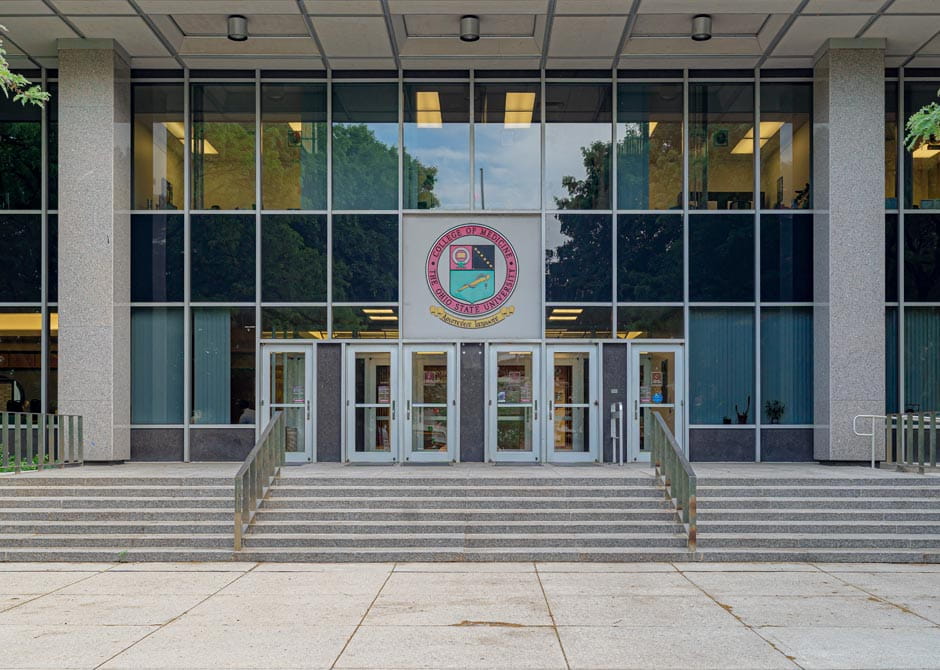
Over a hundred years ago a group of forward-thinking central Ohioans recognized the value of integrating medical education with innovative research and science-based care.
With that in mind, leaders at The Ohio State University opened our College of Medicine in 1914. Since that time, over 20,000 medical alumni have trained at Ohio State. Read more about our rich history and the leaders who have helped shaped it.
-
Ohio State’s College of Medicine was established, beginning a century of leadership in medical research, education and patient care. William Means, MD, was the college’s first dean. William Means, MD, dean of the College of Medicine, 1914-1916.
In 1915, Mabel Roe Codding Clovis became the first woman to graduate from Ohio State’s College of Medicine.
In 1916 Columbus Children’s Hospital affiliated itself with Ohio State’s College of Medicine. In 1918, the two institutions entered an agreement to share talent and resources.
-
Ohio State’s Board of Trustees took a visionary step by dedicating the area along Neil Avenue, between 10th and 11th avenues, as an expansion site for the College of Medicine. Ohio State went on to become one of the few campuses in the nation with medical research, education and patient care within walking distance of other world-class health and science research and education facilities. This proximity is a major contributor to interdisciplinary scholarship leading to medical discoveries.
-
During difficult economic times, there was a push to transform Ohio State’s hospital into a sole charity care provider.
In 1933 The Alpha Omega Alpha Gamma (AOA) Chapter was founded at Ohio State in 1933. AOA is the only academic honor medical society in the world.
-
In response to World War II’s demand for more doctors, Ohio State’s College of Medicine established a two-year pathway to a medical degree.
A surgical giant, Dr. Robert Zollinger redefined surgery at Ohio State and was known for being as challenging to residents as he was kind to patients. Dr. Zollinger and his colleague Edwin Ellison, MD, identified Zollinger-Ellison syndrome, a rare disorder that causes tumors in the pancreas and duodenum, and ulcers in the stomach and duodenum.
-
A trailblazer, Dr. Clotilde Bowen was the first African-American female graduate of the college, the first African-American female physician in the U.S. Army, and the first African-American female colonel. She received the Bronze Star and the Legion of Merit for her efforts to establish drug treatment centers and ease racial tension during the Vietnam War. She was awarded the Meritorious Service Medal in 1974.
Dr. Charles Doan confirmed that humans can live without spleens and that splenectomies can cure certain blood disorders.
-
Arthur G. James, MD, began a personal quest to create the first freestanding cancer center in the Midwest at Ohio State.
Dr. Bertha Bouroncle was a pioneer in cancer research. In one of the greatest scientific breakthroughs ever recorded at Ohio State, she identified hairy cell leukemia and later helped develop an effective therapy for it.
-
An innovator of air and space medical education, Dr. Richard Meiling developed the first hospital-based helicopter rescue service in the United States.
In 1968 Researchers developed the Hunt and Hess scale to classify the severity of a subarachnoid hemorrhage. William Hunt, MD (1921–1999), neurologist and neurosurgeon, chaired the Division of Neurological Surgery from 1964 to 1989. Tolosa-Hunt syndrome was also named after him for his role in its discovery.
-
Ohio State began an innovative program of medical education based on independent study. A three-year medical school curriculum spanned this period and then returned to a four-year curriculum in 1980. In 1973, a three-year and four-year class graduated from the College of Medicine.
A rehabilitation visionary, Dr. Johnson established the nation’s premier program in physical medicine and rehabilitation at Ohio State. He also led the drive to make all of Ohio State wheelchair-accessible, a first for the country.
In 1971 The building housing Ohio State’s School of Allied Medical Professions was completed. Ohio State opened its first helipad, allowing patients to arrive via helicopter.
In 1974 Creative Living, an 18-apartment unit complex, opened just east of Ohio State’s Wexner Medical Center for physically disabled adults as an alternative to skilled nursing facilities. Ernest Johnson, MD, was one of the founders. A second 16-unit building opened in 1986.
-
Bertha Bouroncle, MD, led an Ohio State team that developed a lifesaving drug (deoxycoformycin) protocol to treat hairy cell leukemia, a disease she identified in 1958.
Manuel Tzagournis, MD--1980s and 1990s. From bachelor’s degree to fellowship, and from instructor to dean to leader of the Medical Center, Dr. Tzagournis was recognized as much for endocrinology as he was for being the face of medicine at Ohio State.
-
Before becoming dean of the College of Medicine in 1995, Dr. Bernadine Healy was the first woman admitted to Harvard’s cardiology program, the first female White House science-policy adviser and the first woman to direct the National Institutes of Health. There, she launched the Women’s Health Initiative, a $625 million study of the causes, cures and prevention of diseases that affect women.
-
Ohio State surgeons, already nationally known for leadership in minimally invasive procedures, were the first in North America to perform robotic surgery using the da Vinci Surgical System.
In 2008 The National Institutes of Health awarded a $34 million, five-year CTSA grant to The Ohio State University and Nationwide Children’s Hospital to fund the Center for Clinical and Translational Science Institute (CTSI). It was among the largest research grants in the University’s history.
In 2010 Ground was broken on a major expansion of The Ohio State University Medical Center (now the Wexner Medical Center). The $1.1 billion revitalization of the research, education and patient care spaces, utilities, infrastructure and green spaces across our Medical Center campus was the largest expansion project in Ohio State’s history.
Our state-of-the-art Clinical Skills Lab debuted in 2012.
Looking Forward
Our new strategic plan provides a clear vision for our collective future, affording countless opportunities to imagine and realize amazing new heights. The plan includes a massive 15-year construction program that will set the standard for academic medical centers of the future, creating dynamic research spaces and inventive clinical and learning environments. These advanced facilities and our expert faculty provide students with a unique learning environment that very few places can offer.
Research continues to be a high priority. We are more determined than ever to create an environment where faculty and members of the research community are fully supported. A new multidisciplinary, cutting-edge biomedical research tower will bring together diverse research efforts under one roof to facilitate the discovery process. By creating a culture of excellence and providing our people the unmatched facilities and support, our latest discoveries will translate into more effective treatments and improved wellness for everyone.