
- About this researcher
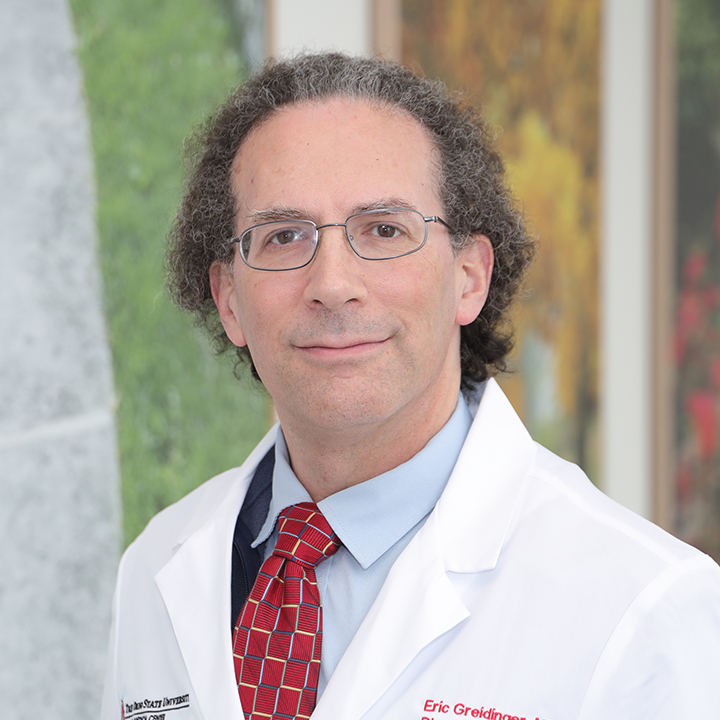
Eric Greidinger, MD
Associate Professor
Internal Medicine
Academic information
- Department: Internal Medicine
- Division: Rheumatology - Immunology
Research interests
- Stimulator of Interferon Genes (STING)
- anti-RNP Autoimmunity
- Autoimmune Vasculopathy
About
Biography
I am the associate director for the Center for Innate Immunity and Inflammation at the Pelotonia Institute for Immuno-oncology at the OSUCCC – James. I’m also an associate clinical professor of Internal Medicine in the Division of Rheumatology and Immunology in The Ohio State University College of Medicine.
My current research is centered on the role of stimulator of interferon genes (STING) in disease. My team and I are focused on developing new inhibitors of the STING pathway as potential therapies for conditions that are untreatable or poorly treatable. In addition to seeking opportunities to leverage STING-related treatment approaches to traditional rheumatic diseases, I am developing opportunities to use STING-related approaches to other conditions, including immune complications of cancer treatment with immune checkpoint inhibitors.
For more than 25 years, my research has been heavily focused on immunopathology and translational studies of anti-RNP autoimmunity. I am continuing my long-term research of anti-RNP rheumatic syndromes, both in humans and with animal models of this spectrum of lupus overlap syndrome. I also helped develop a novel murine model of Sjogren’s syndrome/lupus overlap. My work combines wet lab studies, clinical research analyses, and computational and big data approaches, with the goal of improving disease processes in patients.
My interests and expertise further include mapping the B and T cell responses to established and novel autoantigens in murine and human systems; the characterization of autoimmunity-linked, antigen-specific T cell receptors; and the characterization of the roles of innate immune effectors in the tissue targeting of autoimmune and autoinflammatory diseases.
Additionally, in the case of Raynaud’s phenomenon, I helped identify evidence of an inflammatory/autoimmune basis for conditions not previously recognized as being involved in immune/inflammatory effectors in their pathogenesis.
Throughout my career, I have received more than $2 million in peer-reviewed grant support. I’ve written more than 50 articles published in peer-reviewed journals, primarily focused on the roles of innate immunity in autoimmunity, anti-RNP autoimmunity and autoimmune vasculopathy. In addition, I’m passionate about mentoring the next generation of physician-scientists and look forward to continuing that important work in the Ohio State College of Medicine.
Credentials
Education
- Fellowship - Rheumatology
-
Johns Hopkins University School of Medicine, Baltimore, MD, United States
7/1/1994 - 6/30/1997 - Residency - Internal Medicine
-
University of Michigan Health System, Ann Arbor, MI, United States
6/1/1991 - 6/30/1994 - Doctor of Medicine (MD)
-
University of Michigan Medical School, Ann Arbor, MI
8/31/1987 - 5/24/1991
Certifications
-
American Board of Internal Medicine/Rheumatology
11/20/1996 -
American Board of Internal Medicine
8/24/1994
Research
Research interests
- Stimulator of Interferon Genes (STING)
- anti-RNP Autoimmunity
- Autoimmune Vasculopathy
Awards and Honors
- More than $2 million in peer-reviewed grant support, with more than 50 peer-reviewed publications and more than 30 mentees, in research focused on roles of innate immunity in autoimmunity; anti-RNP autoimmunity; and autoimmune vasculopathy
