
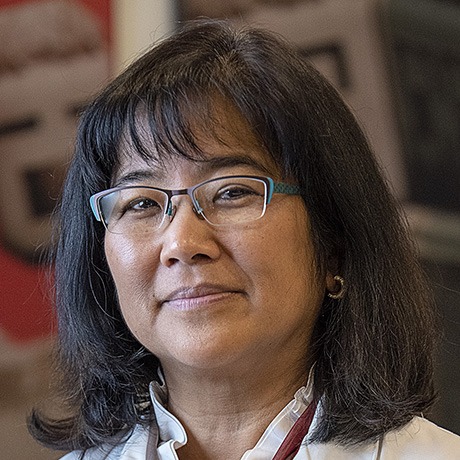
Sayoko Moroi, MD, PHD
Professor
Ophthalmology
Academic contact
Academic information
- Department: Ophthalmology
Leadership titles
- William H. Havener, MD Endowed Professor
- Chair and Director of the Havener Eye Institute
Research interests
- Intraocular Pressure Variation in Glaucoma Treatment
About
Biography
I am Sayoko Moroi, MD, PhD, professor and chair of the Department of Ophthalmology and Visual Sciences in The Ohio State University Wexner Medical Center. I specialize in glaucoma research focused on preventing vision impairment and blindness. My research focuses on improving how we identify risk factors, monitor disease progression and personalize care to achieve better outcomes.
My interest in glaucoma is both personal and professional. Inspired by my father’s experience with the disease, I am driven to combine clinical insight with research to improve patient outcomes and offer hope. Glaucoma damages the optic nerve – the pathway that carries visual information from the retina to the brain – and remains a leading cause of irreversible vision loss worldwide.
Although current treatments including medications, laser therapy and surgery, aim to lower intraocular pressure, some patients continue to experience disease progression. Clinical studies supported by the National Eye Institute and others have identified key risk factors such as thin cornea, family history of glaucoma and fluctuations in eye pressure. Still, these factors do not fully explain why vision loss continues for some individuals.
To address this gap, my research includes advancing how we measure and manage intraocular pressure outside the clinic. We use rebound tonometry devices, such as the iCare HOME instrument, to capture eye pressure throughout the day and night. These real-world measurements help us better understand pressure fluctuations and tailor treatment strategies. Our team maintains a shared library of these devices to support patients and clinicians in personalizing care around this modifiable risk factor.
I am also working to improve access to vision testing through newer technologies. For patients who are unable to complete standard peripheral vision testing, we are using head-mounted display systems that allow visual field testing through goggles. These systems can also assess vision and color vision, expanding our ability to evaluate patients in more flexible and patient-friendly ways.
Another area of focus is genetics. I study how genetic markers relate to disease type, severity, intraocular pressure and the biological pathways involved in glaucoma. This work aims to improve risk stratification, helping us identify which patients are more likely to experience progression and may need more aggressive treatment, while others may be safely monitored.
In addition, I lead efforts in machine learning, deep learning and artificial intelligence to advance precision medicine in eye care. Our multidisciplinary team brings together clinicians, computer scientists and biostatisticians to build large, multimodal data sets that combine de-identified clinical data, high-resolution ocular imaging and functional testing. With strong safeguards to protect patient privacy, we use these data to identify patterns and patient-specific risk profiles that are not visible through traditional approaches.
Through this work, we aim to refine diagnosis, better predict disease progression and personalize treatment strategies, ultimately improving outcomes through more precise and data-driven care. .
Credentials
Education
- Fellowship - Glaucoma
-
Kellogg Eye Center, Ann Arbor, MI
7/1/1994 - 6/30/1995 - Fellowship - Glaucoma
-
Duke University Medical Center, Durham, NC, United States
7/1/1993 - 6/30/1994 - Residency - Ophthalmology
-
Duke University Medical Center, Durham, NC, United States
7/1/1990 - 6/30/1993 - Internship - Internal Medicine
-
Duke University Medical Center, Durham, NC, United States
7/1/1989 - 6/30/1990 - Doctor of Philosophy
-
Ohio State University at Columbus, Columbus, OH
8/1/1982 - 6/9/1989 - Doctor of Medicine (MD)
-
Ohio State University College of Medicine, Columbus, OH, United States
6/1/1982 - 6/9/1989
Certification
-
American Board of Ophthalmology
5/4/1997
Research
Research interests
- Intraocular Pressure Variation in Glaucoma Treatment
Active Funding
The Ohio State University Vision Sciences Research Core Program (OSU-VSRCP)
P30EY032857 (PI: Sayoko E. Moroi, MD, PhD)
09/30/2022 - 06/30/2027
The goal of this project is to provide high quality and cost-effective services to the vision scientists at The Ohio State University in three modules: Core A. Structural and Functional Assessments; Core B. Biostatistics, Bioinformatics and Genetic Analysis; and Core C. Image Analysis and Data Science.
Towards healthy aging: Quantifying vestibular contributors to age-related changes in balance and fall risk
R01AG073113 (PI: Merfeld)
Role: Co-Investigator
09/30/2021 - 05/31/2026
The goal of this project is to develop and test an intervention designed to improve vestibular precision, which could also improve balance and reduce falls.
Research to prevent blindness challenge grant
(PI: Sayoko E. Moroi, MD, PhD)
01/01/2023 - 12/31/2026
The goal of the RPB Challenge Grant is to encourage growth for a newly emerging eye research program and recently appointed department chair at non-grantee ophthalmology departments at university-connected medical schools.
Metabolic imaging to assess mitochondrial stress in the optic nerve and retina
Columbus Foundation, Ann Ellis Fund, CFB24-0561 (PI: Sayoko E. Moroi, MD, PhD)
01/01/2024 - 12/31/2025
The goal of the Ann Ellis Fund grant from the Columbus Foundation is to characterize oxidative stress in the optic nerve and retina and perform a pilot project in “case-control” design to determine if a signal change in oxidative stress can be detected.
Honors and Awards
- Top 100 Women in Ophthalmology Power List, The Ophthalmologist, 2021
- 43rd Annual Midwest Glaucoma Symposium: Delivered four lectures (2020)
- Roger P. Mason, MD Glaucoma Lecture, Howard University, 2020
- Invited talk, “Illuminating our Blindspots and Preventing Blindness," American Glaucoma Society, 2020
- Invited talk, “How to Play in the Sandbox with Optometry," AAO, 2018
- 39th Annual Robert N. Shaffer Glaucoma Lecture, AAO Annual Meeting, 2018
- Top 25 Most Read Article, Ophthalmology, 2015
- Cohort of the Rudi Ansbacher Women Leadership Scholars Program, 2015
- Marquis’ Who’s Who in Medicine and Healthcare, 2014
- International Association of Healthcare Professionals, 2014
- Best Papers from ASCRS/ASOA Symposium, 2013
- ASCRS Best Paper of Session, 2013
- Certificate of Appreciation for Service as Mentor, ARVO Foundation, 2013
Professional Memberships
- American Academy of Ophthalmology
- American Association for the Advancement of Science
- American Glaucoma Society
- American Medical Association
- Association for Research in Vision and Ophthalmology
- Women in Ophthalmology
Editorial Activities
Journal Reviewer for:
- American Journal of Ophthalmology
- Archives of Ophthalmology
- British Journal of Ophthalmology
- Investigative Ophthalmology & Visual Science
- Journal of Glaucoma
- PLOS One