Two College of Medicine students fill spots on University Board of Trustees

Glenn Loomis ’92 MD, sees AI as an opportunity to give doctors more time with patients.

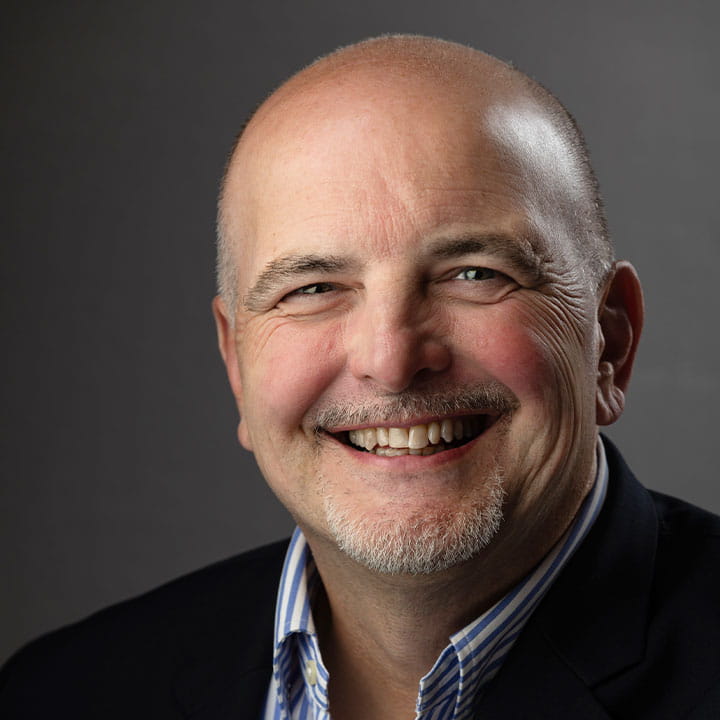
Glenn Loomis ’92 MD, has spent his career at the intersection of medicine, leadership and technology. As founder and chief executive officer of Query Health, he’s now working to reshape how care begins, before a physician even enters the exam room.
A family physician by training, Loomis completed his undergraduate and medical education at The Ohio State University before building a career that’s spanned clinical practice, academic medicine and executive leadership. He served as a residency director, led medical groups and spent two decades as a chief medical officer within health systems. In 2024, he shifted fully into innovation, launching an artificial intelligence (AI) startup designed to address one of healthcare’s most persistent challenges: time.
“Doctor visits basically take 50% of the time extracting data from the patient and then 50% diagnosis and treatment,” Loomis says. “We take that first half of the visit off the doctor’s hands.”
Query Health’s platform centers on an AI-powered assistant that engages patients in conversation before their appointment. It gathers medical history, synthesizes information from electronic health records and produces a structured clinical note for the physician. During the visit, it continues to document the interaction, ultimately delivering a comprehensive record without requiring additional physician time.
The goal isn’t to replace clinicians, Loomis says, but to remove friction from the process so they can focus on what matters most.
“Patients feel like they’re not being heard because we’ve tried to scale by squeezing time,” he says. “This allows the patient to still be heard while helping the doctor scale in a different way.”
Loomis’ interest in AI began years before large language models entered the mainstream. While serving as a health system executive in New York, he worked alongside IBM on applications of Watson in healthcare, IBM’s early AI tool. The technology, he says, showed promise but lacked the reasoning capabilities needed for clinical use.
“It was good at retrieving things, but it couldn’t really think through problems,” he says. “But you could see where the path was going.”
That early exposure led Loomis to deepen his expertise. He pursued board certification in AI in medicine through the American Board of Artificial Intelligence in Medicine and authored an early white paper for the American Medical Association to help physicians understand the technology’s trajectory.
“I could see that doctors had no understanding of what was coming,” he says. “I wanted to get it into our vernacular that we needed to pay attention.”
When advances in large language models accelerated, Loomis recognized a turning point. What once felt years away now seemed within reach.
“Fast forward to 2024, and I thought these models could actually do the job,” he says. “So I formed a company.”
“I’ve always been an innovator, but Ohio State helped me challenge the status quo.” - Glenn Loomis ’92 MD
 Much of the early adoption of AI in healthcare has focused on administrative tasks — documentation, coding and prior authorization. While valuable, Loomis believes those applications only scratch the surface.
“Very little has been done on the clinical side,” he says. “Now you’re starting to see the push into actual clinical medicine.”
What sets Query Health apart, he says, is its integration into the existing workflow of physician offices. Rather than operating as a separate tool or telehealth platform, the virtual assistant works within the systems clinicians already use, pulling in data from health records and health information exchanges before interacting with patients.
“That allows it to personalize the conversation and ask questions the way a doctor would,” Loomis says. “Patients don’t leave out critical details.”
The company, founded in fall 2024, spent much of 2025 building its first product.
It’s now piloting the technology with large medical groups in Ohio and New York, with plans for broader deployment later this year. A team of about 10 employees supports the work, with a goal of reaching 100 providers on the platform by year’s end.
For Loomis, the promise of AI extends far beyond efficiency. He sees it as a tool to expand access to reliable medical information, particularly to those in harder-to-reach, rural communities.
“It’s going to help us take better care of patients and extend ourselves to improve access,” he says. “More importantly, it can democratize access to great medical information.”
That perspective is shaped in part by his travels. Loomis has visited all seven continents, an experience that has informed both his worldview and his approach to innovation. One encounter in West Africa left a lasting impression.
While visiting The Gambia, Loomis met a driver who described ongoing health concerns but hesitated to seek care due to cost and distance. Months later, Loomis learned the man had died from complications related to sickle cell disease.
“Nobody should die of a sickle cell crisis,” Loomis says. “If he had access to something like this, he would have known what it was and that he needed to go in.”
The experience reinforced his belief that technology can close critical gaps in care, not by replacing physicians, but by extending their reach.
“In a lot of places, there are very few doctors, but everyone has a phone,” he says. “Putting that information in people’s hands can change the health of the world.”
“Real progress comes from finding ways to help more people, not just doing the same work faster.” - Glenn Loomis ’92 MD
Loomis traces his approach to problem solving back to his time at Ohio State, where he built an individualized undergraduate path that combined biology and psychology before entering medical school.
“I’ve always been an innovator, but Ohio State helped me challenge the status quo,” he says.
Experiences during his medical training — including a clinical rotation in England — broadened his perspective on how care can be delivered.
“It taught me that patients are all the same, but we can treat things very differently and still get good outcomes,” he says. “It made me think outside the box.”
That mindset continues to shape his work today, particularly as he engages with students and alumni interested in the future of medicine.
“This isn’t a fad,” Loomis says of AI. “It’s not going away, and it’s not going to replace doctors. It’s going to help us do our jobs better.”
As AI continues to evolve, Loomis sees a future where technology supports more connected, informed and equitable care, from large health systems to the most remote corners of the world.
“I think it’s going to connect areas that are underserved today to the best information available,” he says.
For Loomis, that vision is both professional and personal. It reflects decades of experience in medicine, a lifelong curiosity about technology and a belief that better tools can lead to better health outcomes.
“Real progress,” he says, “comes from finding ways to help more people, not just doing the same work faster.”