Two College of Medicine students fill spots on University Board of Trustees

Supported by university-wide collaboration, a new AI service core at the College of Medicine aims to accelerate breakthrough discoveries.
The Ohio State University is at the forefront of the artificial intelligence (AI) revolution, exploring the use of AI to accelerate research discoveries and prepare learners to work with emerging technologies. To support this effort, Ohio State established AI(X) Hub, a universitywide initiative that brings together experts from 15 Ohio State colleges and across disciplines to expand AI capabilities in several key pillars: the arts, business, engineering, healthcare and science. The initiative is led by Ness Shroff, PhD, in the departments of Electrical and Computer Engineering and Computer Science and Engineering.
The hub’s AI for Health pillar aims to harness Ohio State’s vast clinical and scientific expertise in healthcare to drive meaningful change in medicine, finding solutions to address some of the most pressing challenges locally and globally.
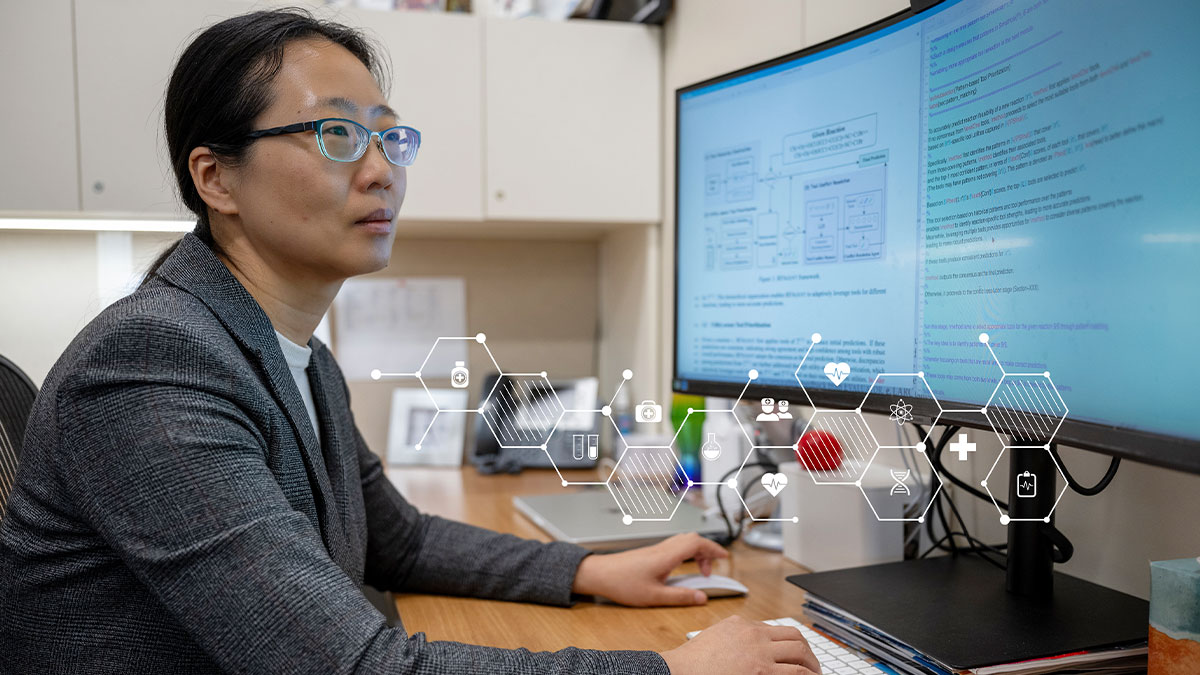
The lead at the Hub AI for Health is Xia Ning, PhD, ’24 MBA, professor and Division chief of Artificial Intelligence in Digital Health in the Department of Biomedical Informatics at the College of Medicine and professor of Computer Science at the College of Engineering.
Ning’s work in foundational methodology development in AI and machine learning has the potential to transform how future therapies take shape. She and her team work with AI models that craft and refine new molecules in seconds.
“AI helps us interpret large amounts of data quickly, accelerating the identification of promising chemical compounds that can lead to breakthrough discoveries and viable drug candidates,” she says. “In our work, we intertwine the tools of AI into teaching and advancing healthcare outcomes.”

Ness Shroff, PhD, is the leader of the AI(X) Hub, which spans 15 colleges and aims to unlock the exponential possibilities of the technology. Shroff is one of the key contributors to the university’s new AI curriculum. He works in the departments of Electrical and Computer Engineering and Computer Science and Engineering.
Ning says one way to envision this is to think of her and AI as co-directors. AI integrates clinician knowledge and insight and mines accurate information, expanding her team’s ability to validate findings and move discovery forward. This sets them as partners to tackle areas in basic science research that still exist in the realm of unknowns.
“We do not always know which genes are responsible for which diseases — or how close we’d be to developing an effective new medicine because a specific compound was overlooked due to the mind’s constrained ability to examine large amounts of data at once,” Ning says.
AI changes all of that.
“[The AI(X) Hub] contributes to us making informed decisions that lead to new breakthroughs in early disease detection, more effective drug discovery and clinical applications that will have profound and lasting impacts.” - Xia Ning, PhD, ’24 MBA
This means researchers like Ning no longer have to sift through and analyze large amounts of data to review promising identified molecules. They can now use generative AI to predict how certain molecules bind to protein targets and synthesize chemical reactions. In the past, it used to take months to develop a sequence of molecules to be analyzed and adjusted to end up with workable options. AI does this in just days.
Interdisciplinary collaboration and learning to work with existing data are the new normal, leading to new approaches, Ning says. She gives an example of a suggestion by a collaborating chemist who offered a whole new strategy for molecule discovery.
“He encouraged us to start from the final molecule that we want to make and look at which bonds are broken during reactions,” Ning says. “So, essentially, we start there and work backward.”
This approach gave Ning and her team a different and new idea on how generative AI can do the job with better results compared to any existing tools.
“Preclinical drug discovery is shortened to minutes instead of months or years,” she says, allowing the team to move to the clinical trials process faster.

Target to lead refers to the process of identifying of a ‘lead’ molecule that is a suitable candidate for initial drug development. Source: doctortarget.com/home/machine-learning-applied-drug-discovery
Ning is currently working with College of Medicine leadership to develop a central AI service core, a program that will provide faculty, researchers, learners and clinicians with support and access to data analysis, as well as access to consultations and application and algorithm development.
Guided by the College of Medicine’s new AI and Medical Education Task Force, the core is actively weaving AI literacy into medical education and research, from early coursework and clinical training to simulation, assessment and faculty workflows. This coordinated, long-term approach is centered on ethical use, curricular integration, innovation and faculty support as these tools become part of everyday patient care and research.
Ning says the core will establish a medicine-centered AI practice in which experts refine existing tools to support major research programs and strengthen learning in basic and translational science. The goal is to help everyone use AI tools and resources effectively in the field.
“We all need different types of AI methods and techniques,” Ning says. “Providing expertise to develop methodologies and best practices will help everyone learn how to form and apply new knowledge.”
And, she adds, users will have access to specific and standardized data, such as imaging data and large language models built from existing data.
“Researchers can go to the core and use existing models and connect their thoughts across AI in the medicine pathway,” Ning says. They can also work with other principal investigators on the research and implementation stage, down to the final product, she says.

Ning says the new medicine-centered Ai service core will provide extensive resources for researchers, learners, faculty and clinicians.
AI’s ability to transform vast datasets such as electronic health records (EHRs), medical imaging and patient-reported outcomes into validated knowledge and actions accelerates discovery, Ning says. She and her team use AI to develop tools that help health practitioners quickly identify the most vital information from EHRs, contributing to faster diagnosis and treatment for patients in acute care settings like the emergency department.
During clinical examinations, for example, physicians are already employing AI’s ambient tool that records their verbal interactions with patients, allowing them to spend more time fully focused on what their patients are saying and less time inputting notes into the computer.
Ning and her team are also developing models that can predict Alzheimer’s disease years before symptoms appear.
Education and training are the next focus for the AI(X) Hub. In May, the College of Medicine and the hub hosted the “AI for Health Research Symposium,” which brought together researchers and experts, including physicians, clinical investigators and biomedical scientists, to gain insight into current AI capabilities in healthcare and biomedical research.
In addition to the exchange of information on topics covering everything from data curation to AI applications, participants made important connections to pursue collaborative research and application development, elevating team science across disciplines, Ning says.
“It’s an exciting time for everyone involved with the AI(X) Hub and the future AI service core,” she says.
“This contributes to us making informed decisions that lead to new breakthroughs in early disease detection, more effective drug discovery and clinical applications that will have profound and lasting impacts,” she says.