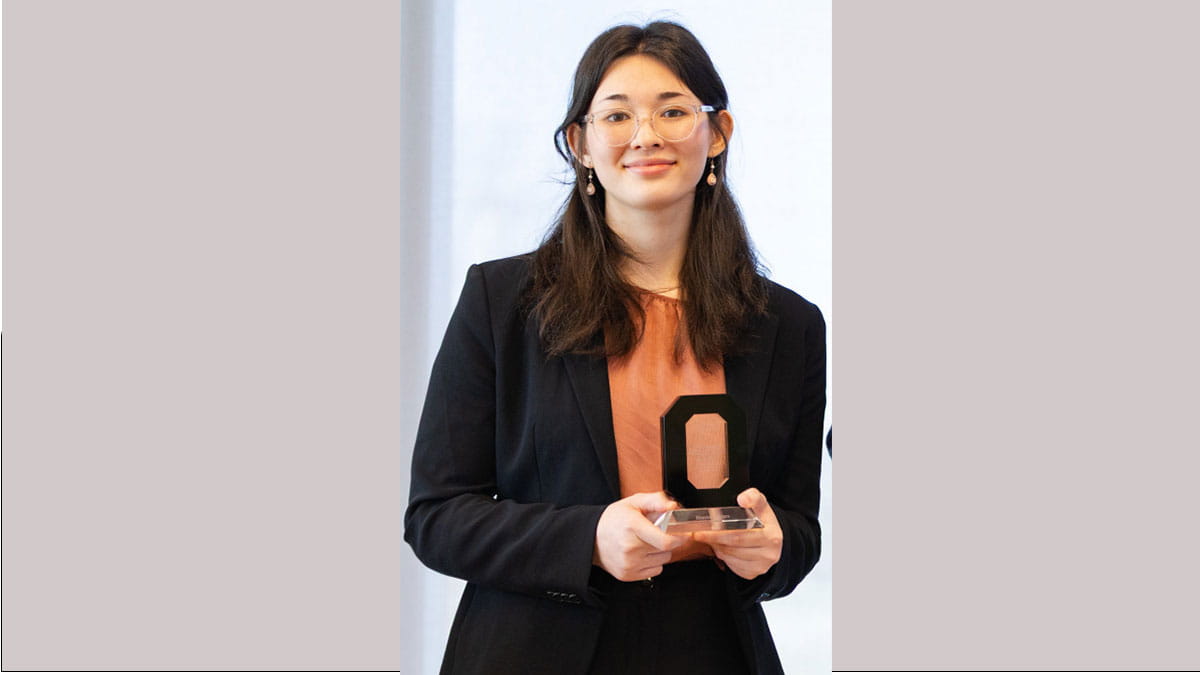
Hannah Myers was named The Ohio State University’s Next Generation Innovator of the Year by The Ohio State University’s Enterprise for Research, Innovation and Knowledge (ERIK). This award recognizes postdoctoral students, graduate students and undergraduate students involved in innovation and entrepreneurship through contributing to the development or commercialization of a new technology or a startup they’ve initiated.
Because hospital environments can be ripe with dangerous invisible contamination that introduces nosocomial infections that put immunocompromised patients at major risk, Myers began her research last May leading to her creating an innovative device called PathoTrace, a test strip and mobile application designed to identify mold, bacteria and viruses in indoor environments.
Myers, who is a second-year undergraduate student in Computer Science and Engineering, credits a conversation with Mark Drew, PhD, clinical associate professor of Microbial Infection and Immunity in The Ohio State University College of Medicine, with sparking the idea to pursue creating a technique to identify invisible pathogens that pose serious risks to vulnerable patients.
Together, they came up with the phrase “flypaper for microbes” to describe the kind of simple, passive detection tool that would be incredibly useful – if Myers could make it work. She did. And Dr. Drew credits her energy, creativity and ability to develop innovation in a technically ambitious way as leading to her success.
She also built a team and pushed the innovative idea forward. She began researching how to develop a passive, visual detection system that could both collect and reveal contaminants in a simple, accessible way.
PathoTrace works by:
- Adhesive gel tape passively capturing airborne particles, while an indicator system reveals microbial activity through color change.
- Detecting types of molds accurately and more quickly than what is currently available. Myers was able to collect house dust from places all over the United States and from different households with different concentrations of mold.
- Incubating the samples at different humidities and after waiting a week, reviewing them.
- Extracting the RNA that is in the dust, from the mold that has grown, and analyzing it to determine which genes are very prominent and which genes they should be looking for when detecting mold.
- Developing an app that reads the strip and provides users with information about which allergens are present.
Myers says she has wanted to be a scientist since she was a child consumed with curiosity, wonder and drive. Developing these traits led her to interact with faculty and researchers at the college who inspired her to start the journey to pursue research, build products and start a company. The PathoTrace venture was the winner of the BOSS Space Ventures competition in September 2025 and was just awarded $50,000 in funding at Ohio State University's 2026 President's Buckeye Accelerator finale let by the Keenen Center for Entrepreneurship.