
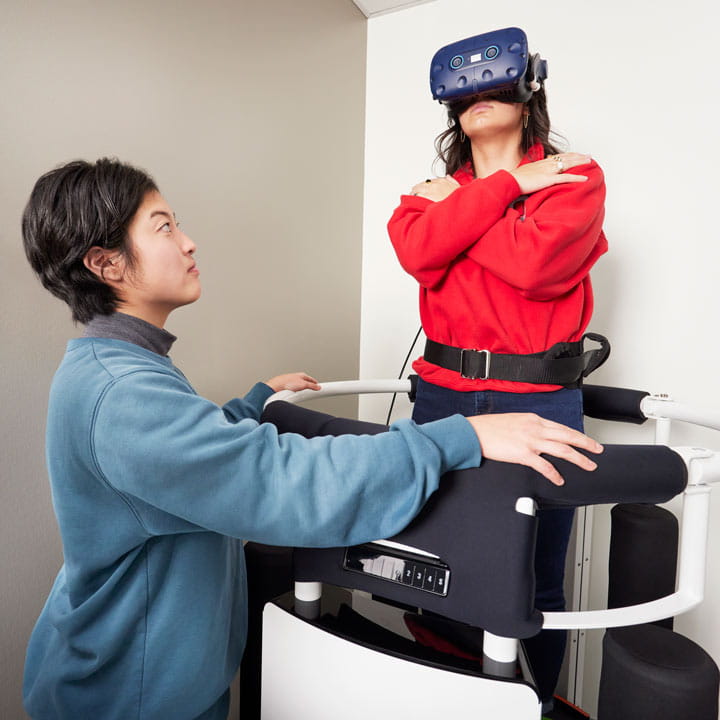
 A major expansion of the Vestibular Research Laboratory at The Ohio State University Wexner Medical Center is accelerating efforts to quantify balance dysfunction and develop evidence-based tools to identify patients at heightened risk for falls, one of the leading causes of injury and mortality among older adults. The additional square footage, funded primarily by the Department of Otolaryngology – Head and Neck Surgery, has enabled laboratory director Daniel Merfeld, PhD, professor in the Department of Otolaryngology – Head and Neck Surgery, to install a new suite of advanced motion-testing platforms that significantly broaden the lab’s research capabilities.
“These upgrades allow us to investigate the interplay between vestibular decline, balance and falls in ways that simply were not possible before,” Dr. Merfeld explains. “Our previous equipment allowed us to measure only one degree of freedom at a time. With our newest systems we can measure three degrees of freedom, and with further expansion we anticipate the ability to measure all six.”
By enabling precise measurement of motion perception and vestibular precision, these technologies directly support the development of clinical fall-risk assessments and targeted interventions for older adults.
Critically, this work has significant potential to reduce injuries, hospitalizations and loss of independence in at-risk patients.
Technology to accelerate discovery
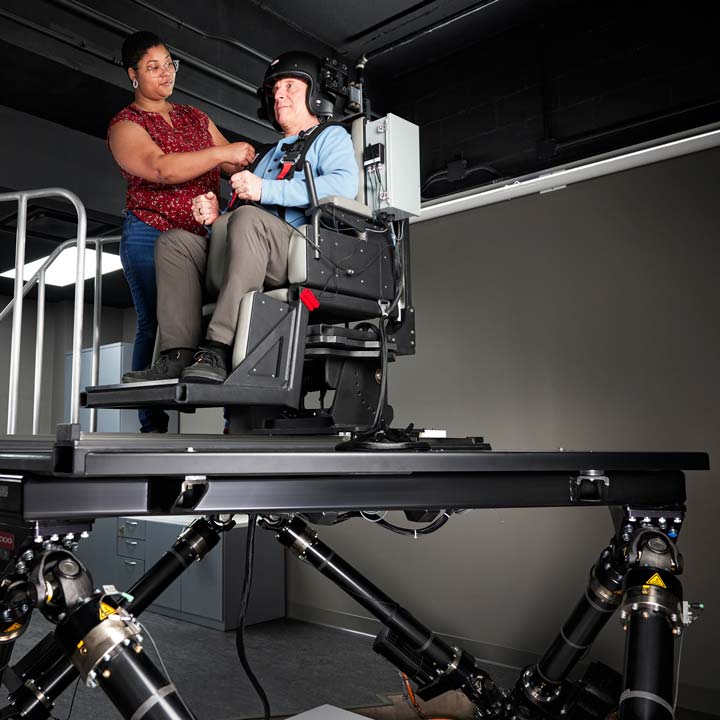 Since 2017, the vestibular lab has served as a central hub for NIH-funded basic and translational research. Prior studies from Merfeld’s group and collaborators demonstrated that vestibular degradation accelerates after age 40, and that nearly half of age-related balance decline is mediated by increases in roll-tilt thresholds, a key measure of vestibular precision.
To extend this work, the lab has begun collecting data from its Virtualis Motion VR system, which uses immersive virtual environments to assess balance, and two Moog motion platforms that facilitate detailed human perceptual testing. These systems enable investigations not previously possible with single-axis platforms.
The next phase of the expansion centers on P3OSTURE (Portable Posturography Platform for Optimized Sensory Organization Testing, User-specific Rehabilitation, and Evaluation), a compact device initially designed for the U.S. Department of Defense to evaluate vestibular and sensory deficits in active-duty service members.
“Because we plan to use this device to study both balance and vestibular function, it will allow us to enhance our studies of balance as well as test techniques we’ve developed to improve our ability to measure tilt thresholds,” Dr. Merfeld says. “We’re about to launch a clinical trial testing these techniques among older adults, to see if improved vestibular precision improves balance and ultimately reduces falls.” P3OSTURE’s small footprint also makes it suitable for deployment in clinical exam rooms, senior centers and community fall-screening programs, laying the groundwork for real-world clinical translation.
Studying vestibular function under hypoxic conditions
Another important addition to the laboratory is a custom-built Hypoxico Altitude Chamber equipped with dual Sierra 100 Altitude Generators and advanced, sensor-driven control software capable of simulating altitudes up to 15,000 feet. This infrastructure enables controlled investigation of how mild hypoxia, similar to that experienced at 8,000 feet, affects balance and vestibular performance.
Dr. Merfeld, who collaborates with the Naval Medical Research Unit at Wright-Patterson Air Force Base, notes that this system’s modular design maximizes space efficiency while providing the environmental precision required for high-quality research. Findings from this work are expected to clarify how altitude, respiratory disease or frequent air travel may influence fall risk in susceptible individuals.
Toward scalable clinical impact
“With the completion of the vestibular lab expansion and full implementation of our new equipment, we anticipate being significantly closer to developing a clinical test that evaluates both balance and fall risk,” Dr. Merfeld explains. “And as smaller devices like P3OSTURE become more widely available, this test could be scalable to a doctor’s office, senior center or other facilities that conduct fall screenings.”
The ultimate goal is to translate advanced vestibular science into accessible clinical tools that allow earlier identification of balance deficits and enable clinicians to intervene before falls occur. Such interventions have the potential to significantly reduce injury, preserve independence and improve quality of life for older adults.
“As chair of the Department of Otolaryngology – Head and Neck Surgery, I am very excited about the innovation taking place in Dr. Merfeld’s laboratory,” Dr. Rocco says. “The expansion of the vestibular lab and integration of advanced motion-testing technologies reflect our commitment not only to scientific discovery but to improving outcomes for patients at risk for falls. By advancing the precision with which we assess balance and vestibular function, this work brings us closer to clinical tools that can be broadly deployed to help clinicians intervene earlier, prevent injuries and support independence for aging adults. This is exactly the kind of translational impact that defines our department’s mission.”