
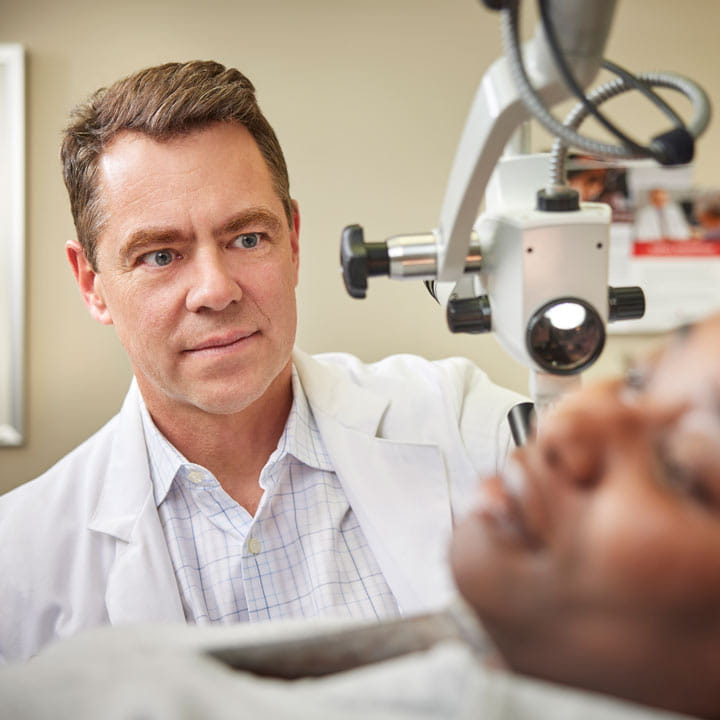
 Complex lateral skull-base surgery demands exceptional coordination across surgical specialties. At The Ohio State University Wexner Medical Center, a long-standing partnership between Otolaryngology – Head and Neck Surgery and Neurosurgery has evolved into a highly integrated model that elevates surgical precision, efficiency and patient outcomes. This collaboration is led by Oliver Adunka, MD, MBA, professor and Director of the Division of Otology/Neurotology and Cranial Base Surgery, whose team works jointly with neurosurgery on more than 100 lateral skull-base operations each year.
“At Ohio State, we offer several different surgical approaches to skull-base procedures, and you need a multidisciplinary team to take care of these patients as a well-oiled machine,” Dr. Adunka explains. “It takes a village for these surgeries, and our partnership is second to none.”
Lateral skull-base approaches – accessing tumors or other pathologies through the temporal bone – require precise navigation around the ear, middle cranial fossa and posterior fossa structures. These approaches are used to treat acoustic neuroma, cerebrospinal fluid leaks, petrocival meningiomas, superior semicircular canal dehiscence, malignancies of the temporal bone and skull base, epidermoid tumors and a range of rare disorders.
A fully integrated surgical model
Although lateral skull-base procedures typically involve multiple specialties, national practice patterns often divide the operation into discrete stages, with one team gaining access to the tumor and the other performing resection. At the Ohio State Wexner Medical Center, the model is deliberately more cohesive.
“Traditionally, work is divided so one team provides access to the tumor, and the other takes it out,” Dr. Adunka notes. “Our approach is a bit more different and more collaborative. We work on tumor dissection as a team. It’s not a division of labor, but more of a flexible approach.”
This approach allows both neurotology and neurosurgery teams to manage any element of the operation, stepping in seamlessly during complex dissection or reconstruction. “Four eyes are better than two,” Dr. Adunka emphasizes. “Our approach means more simultaneous work and better continuity between our tasks. It’s so seamless to work as a team that it’s our preference. For patients, this equates to more streamlined and higher-quality care.”
These half-day to full-day procedures are performed at The Ohio State University Comprehensive Cancer Center – Arthur G. James Cancer Hospital and Richard J. Solove Research Institute, with additional involvement from radiation oncology, physical therapy and other specialties. “This is a complex part of the body anatomically,” Dr. Adunka explains. “Each of us has a different skill set, and combining them leads to synergistic results.”
“I view this collaboration as a model of how multidisciplinary integration elevates care for patients with the most complex skull-base disorders,” says James Rocco, PhD, chair of the Department of Otolaryngology – Head and Neck surgery.
“Under Dr. Adunka’s leadership, our program has developed an approach that seamlessly blends the expertise of our Neurosurgery colleagues – including Drs. Lonser, Prevedello and Wu – with the strength of our Neurotology faculty, Drs. Dodson, Schoo, Ren and Macielak.”
“This collective depth of experience creates an unparalleled environment for surgical precision, real-time problem solving and coordinated care. It also offers an extraordinary training opportunity for our Neurotology fellows, whose exposure to such high-volume, highly integrated skull-base surgery helps ensure that our Neurotology fellowship remains one of the most desirable programs in the country. Together, this partnership exemplifies our department’s commitment to innovation, teamwork and delivering the highest standard of care for patients with lateral skull-base disease.”