
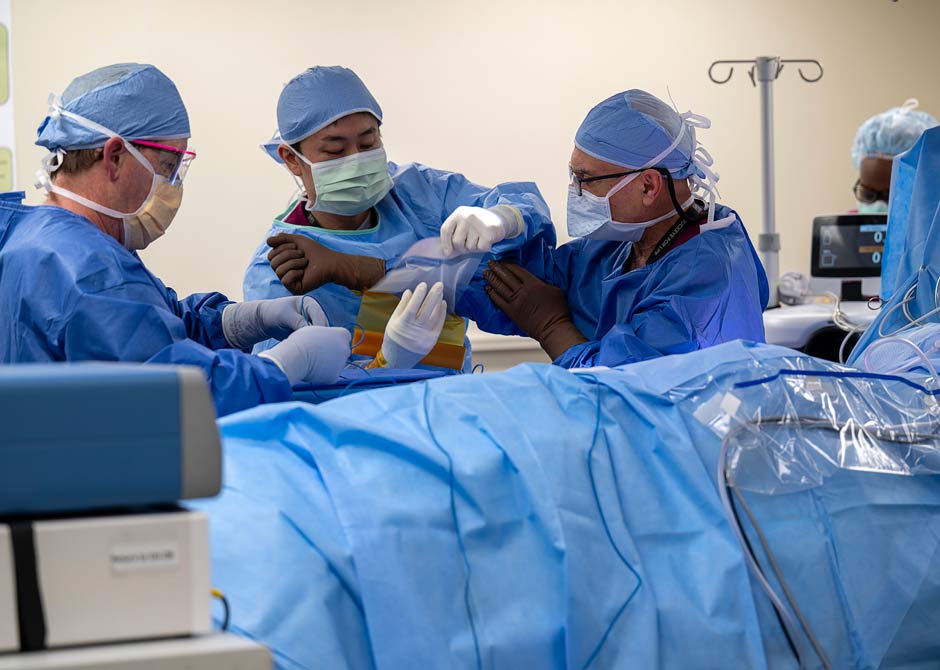
 In December 2024, 10 healthy people each donated a kidney to someone they’d never met, saving that person’s life.
The 10-way paired kidney transplant chain was the largest such operation in the history of The Ohio State University Wexner Medical Center, and one of the largest single-institution transplant chains ever performed in the United States.
The undertaking was massive: two days, seven transplant surgeons, 18 hours in operating rooms, 20 patients, 2,207 instruments and untold thousands of hours planning by the hundreds of medical center staffers involved. And until the last surgery was complete, the medical team held its breath knowing that any one donor or recipient could get sick or injured, and the entire chain would be disrupted.
How it started
The clinical origin of the chain started with Mike Lange, BSN, RN, PCCN.
Lange is a living donor transplant coordinator at The Ohio State University Comprehensive Transplant Center. In October 2024, Samantha Fledderjohann had come forward to donate a kidney, and she didn’t have anyone in mind for it. In strict medical language, these folks are called “nondirected donors,” but around the Transplant Center, you’re just as likely to hear them referred to as “heroes.”
Samantha had asked to proceed with the surgery in mid-December, so Lange started looking at the list of people awaiting transplants. He found Scott Humes, whose brother-in-law Shawn Carnahan had a kidney ready to donate. The two weren’t a match, though, so Scott got Samantha’s kidney, and Shawn’s went to another recipient whom Lange matched him to through the list.
The matches just kept going like that, until he had 20 people total.
“Once you have a nondirected donor, we try and look at every opportunity we can and how many people we can impact,” Lange says. “Why not try to get as many people off the list and benefit from this one person? It was like a cascade.”
Expertise in kidney transplant
Once everything was in place, the chain began, fittingly, with Amer Rajab, MD, PhD.
Dr. Rajab, Ohio State’s surgical director of Kidney and Pancreas Transplantation, performed the first of the 20 surgeries, removing Fledderjohann’s kidney the first morning. He removed two more kidneys that day, then another three on the second day. It’s routine for him at this point – he’s removed more than 1,500 of them in his 25 years at Ohio State.
Austin Schenk, MD, PhD, was among the other six surgeons who operated on patients in this chain. After one challenging kidney extraction on the first day, he remarked with admiration: “Everything takes longer for us to do than it does for Dr. Rajab. The rest of us are human.”
Dr. Rajab’s expertise is just one reason a chain this large can take place at Ohio State. More than 13,000 organ transplants have taken place here since 1967 – more than half of them kidneys.
There are more than 105,000 people awaiting transplants for all organs in the United States, and almost 90% of those people need kidneys.
“We prepare and check, but our recipients aren’t healthy, so you always worry that anything can happen,” Dr. Rajab says. “Literally, anything could have stopped the chain, but there were no hiccups whatsoever. We’re very happy, and the most important thing is that my patients are happy.”