
Brian Bognar – Esophageal Cancer Patient
Robotic surgery offers a promising solution
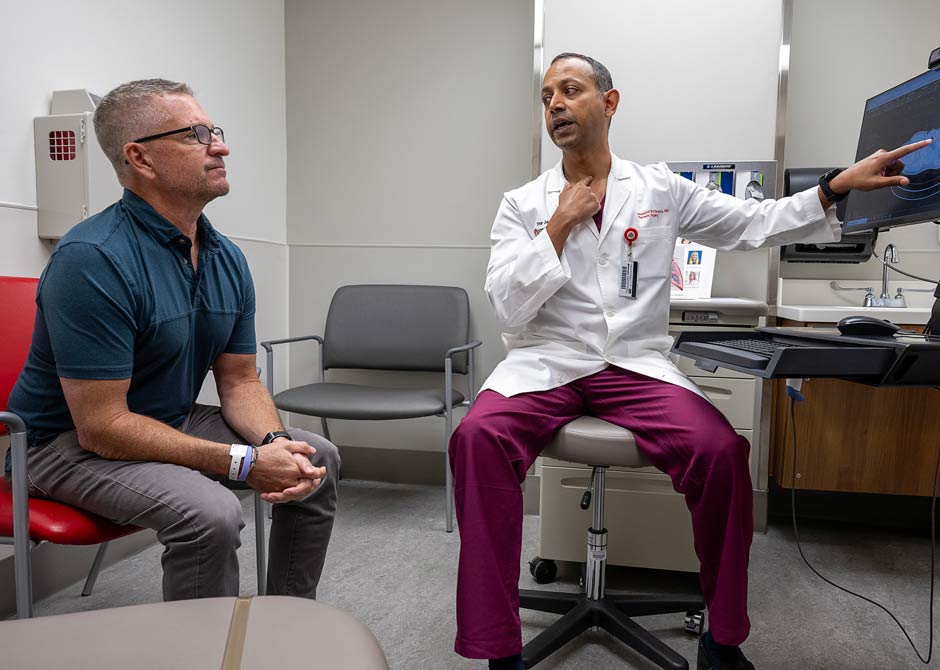 Though Brian Bognar dealt with acid reflux much of his life, it was never severe until a family trip to Chicago during the fall of 2023.
Stomach acid seemed to stay in his throat. He couldn’t eat. He couldn’t sleep.
It was the only sign of what he would discover several months later: cancer in his esophagus.
At the time, his daughters were 11 and 13. Brian was 51.
“I still considered myself young,” he says.
And yet, he wondered: Will I live to see my daughters grow up and go to college?
Before deciding on a treatment plan, Brian and his wife, Erin, met with doctors at Indiana University Hospital near their home north of Indianapolis, and those at the Mayo Clinic.
Two of Brian’s friends suggested he see Desmond D’Souza, MD, a thoracic surgeon at The Ohio State University Comprehensive Cancer Center – Arthur G. James Cancer Hospital and Richard J. Solove Research Institute (OSUCCC – James).
Dr. D’Souza offered Brian an option the other two institutions hadn’t: a minimally invasive, robotic-assisted surgery to remove the cancer and create a new esophagus from his stomach. Robotic surgery would allow Brian to recover faster than from a traditional open surgery. Also, Brian wouldn’t need a feeding tube for any amount of time after the surgery.
Dr. D’Souza, a clinical professor of Surgery at The Ohio State University College of Medicine, had trained other surgeons in robotic surgery, including those at the Mayo Clinic. Along with that expertise, he offered Brian and Erin hope.
“He was the first doctor who told me, ‘You’re going to be OK. This is something we can deal with. You’re healthy enough. You’re young enough,’” Brian says.
“I often have to talk patients off the ledge the first time I meet them,” Dr. D’Souza says. “When you hear you have esophageal cancer, the first thing you do is get on Google and look at the five-year survival rate, and it looks abysmal.”
 If cancer of the esophagus is caught early and hasn’t spread beyond the original tumor, the average survival rate five years after diagnosis is 48%. That drops to 5% if the cancer spreads to other organs.
“But there are always outliers,” Dr. D’Souza says of people whose odds of surviving beyond five years may be low, but who live long past that. “As treatments improve and surgery continues to evolve, your chance of being an outlier is much better.”
Through small incisions, Dr. D’Souza removed the cancerous part of Brian’s esophagus and created a new esophagus using his stomach. He was left with a stomach about half the size of the original.
“I went from, ‘Is this going to kill me?’ to having a complete response to treatment. I went from the lowest of lows to needing to watch what I eat and drink. It’s not the end of the world,” he says.
Having survived cancer led to another change.
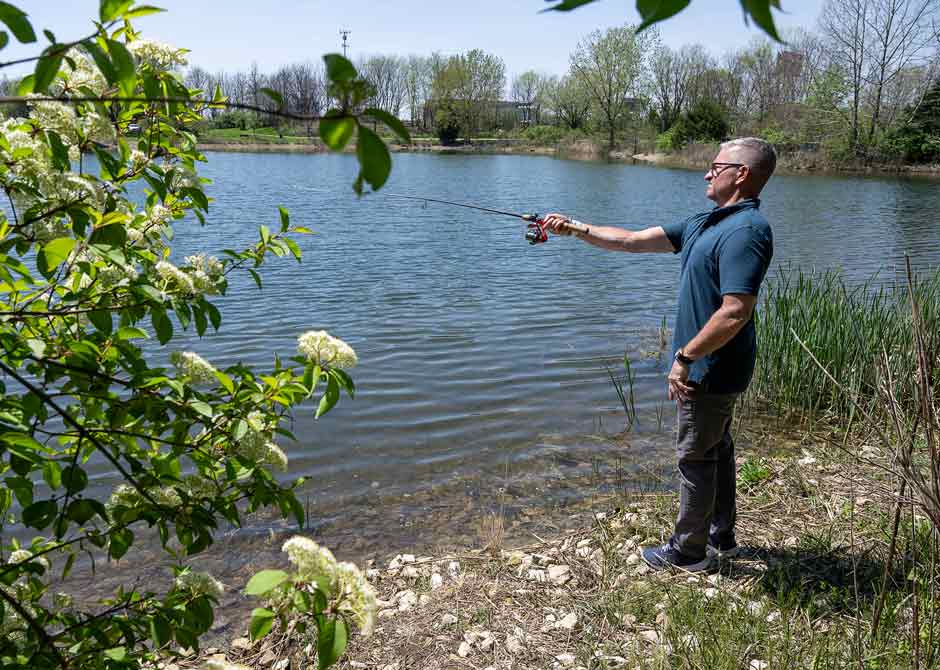
Being from Indiana, Brian has long been a fan of Notre Dame. He never rooted for the Ohio State Buckeyes – never wanted to. He’s still a Notre Dame fan. But now he has a soft spot in his heart for the institution he credits with why he’s still alive today, still spending weekends in a boat, fishing or untangling the lines his daughters cast as they learn their dad’s favorite pastime.