
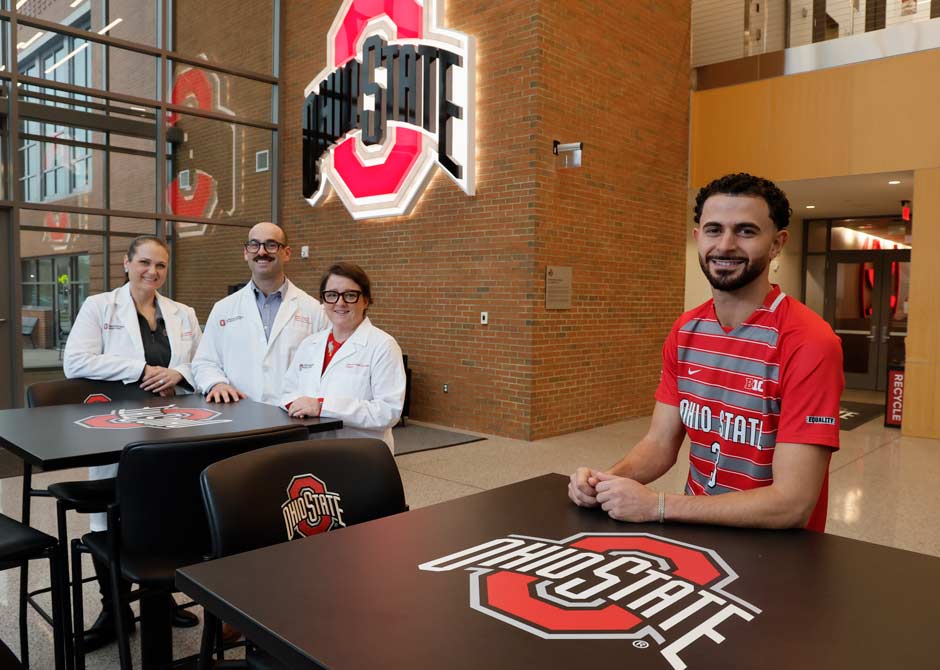
 When Ohio State Buckeye soccer fans filled the stadium in October to watch their team play the University of Wisconsin, few knew they were witnessing a miracle. But for the physicians who cared for senior captain Nathan Demian, watching him play was a feat they never imagined a few months prior.
In December 2024, Demian was a victim of gun violence. The Buckeyes had just reached the College Cup – college soccer’s equivalent to the Final Four. Demian was still celebrating when a random act of gunfire changed his life. He was almost home when a stray bullet from a car chase struck Demian in the stomach.
A mere eight months later, Demian returned this fall to play soccer.
“As a trauma surgeon, the most rewarding thing I can see is my patient returning to the exact life they had before they were injured,” says Jennifer Knight Davis, MD, a critical care surgeon who treated Demian at The Ohio State University Wexner Medical Center Emergency Department.
Surgery teams work seamlessly
Andrew Young, MD, the trauma surgeon on call, quickly assessed Demian to find his blood pressure fluctuating and fluid in his abdomen.
“When the injury is in the chest or belly – you have very little time to wait for surgery,” he says.
Within minutes, Demian was in the operating room where Dr. Young’s team worked to stop the active bleeding. The trauma surgery team closed multiple large blood vessels and parts of Demian’s bowel to stabilize his blood pressure.
Hours later, Dr. Knight Davis seamlessly took over Demian’s care from Dr. Young.
“Transitioning care between our colleagues requires a great deal of training, practice and trust in each other to operate as if you had one person taking care of you,” she says.
Her team’s task was to put the multiple injuries back together. At the time, she wasn’t thinking about Demian’s soccer career. Instead, she was focused on what he’d need to live a normal life. That meant figuring out how to save as much of his bowel as possible to absorb normal oral nutrition.
“Unfortunately, Nathan had to have a colostomy, which is not ideal for a young person, but because of where his injuries were, we needed to minimize infection,” she says.
The trauma surgery team at Ohio State trains year-round to operate in carefully choreographed synchrony. Dr. Knight Davis once counted all the healthcare providers who support trauma patients in the first 48 hours after a severe injury and came up with more than 70 different roles.
Getting stronger, one day at a time
As Demian fought his way back to health, he needed to gain back 30 pounds, plus retrain for strength, speed and agility. He also needed multiple colon procedures.
“The most impressive thing was his desire and his strong goals. He was willing to do anything to get back on the field,” says Lisa Cunningham, MD, the colon and rectal surgeon who reversed Demian’s colostomy.
Returning to the game he loves
As Dr. Knight Davis watched Demian’s return to the field this fall against the Wisconsin Badgers, she couldn’t help but reflect on the night she helped save his life. The Buckeyes on the pitch, in many ways, operated similarly to the trauma surgery team.
“On the field, there’s a lot of communication between the players, anticipating what’s coming, collaboration, role delineation and rapid pace of change. That’s very similar to what it’s like to take care of injured patients,” she says.
Seeing his life nearly end has made Demian focus on his future. He hopes to one day become a physician, giving others a chance at life just as Drs. Young, Knight Davis and Cunningham did for him.
“Without them, I wouldn't be here. They gave me the greatest gift of a second chance at life,” Demian says.