
Exploring Research. Advancing Discovery. Inspiring Future Physician-Scientists.
The ASPIRE Medical Research Program is a year-long physician scientist pathway program designed for Ohio State undergraduate students who are interested in exploring the intersection of medicine and biomedical research.
Communities across the nation continue to be impacted by disparities in healthcare access and health outcomes related to social determinants and inadequate access to translational research and culturally competent healthcare. Research experience and training for students from communities affected by health and healthcare disparities are critical to building a workforce for all and unlocking collaborative solutions to complex healthcare problems.
As an initiative of the Medical Science Training Program, the ASPIRE Medical Research Program's mission is to support undergraduate students whose backgrounds have not afforded them the opportunity to engage in the health sciences. The program provides participants with mentorship, research experience in world-class laboratories, and personal and academic support to prepare them for advanced education and careers as healthcare providers. Ultimately, we envision that our scholars will be considered undeniably competitive during the post-undergraduate portion of their training career.
Through a paid summer research experience, faculty mentorship, professional development programming, and career exploration opportunities, ASPIRE provides students with meaningful exposure to biomedical research and the many ways scientific discovery contributes to improving human health.
Whether students are already considering a career in medicine and research or are just beginning to explore their interests, ASPIRE provides opportunities to build skills, gain meaningful experience, and learn from researchers, physicians, and other professionals across the academic medical center.
Applications open November 16, 2026.
Program at a glance
- Year-long physician scientist pathway program
- Paid summer biomedical research experience
- Faculty and research mentor guidance
- Professional development programming
- Research poster presentation
- Career exploration opportunities
- Community of peers with shared interests
- No prior research experience required
Program overview
Spend your summer doing research
At the heart of the ASPIRE experience is a paid summer biomedical research experience.
You would be paired with research mentors and become part of active research environments where you contribute to ongoing projects, develop research skills and gain firsthand insight into the scientific process. Through hands-on learning, you explore how biomedical research advances knowledge, improves healthcare and contributes to scientific discovery.
For many people, this experience serves as their first opportunity to participate in research and explore careers that combine medicine and science.
No prior research experience is required.
Could ASPIRE Be a Good Fit for You?
There is no single "ideal" ASPIRE student. Participants come from a variety of academic backgrounds, experiences and career interests.
If some of the statements below resonate with you, ASPIRE may be worth exploring:
- You're curious about research and how scientific discoveries improve human health.
- You're interested in combining medicine and biomedical research
- You would like to gain research experience and mentorship.
- You're considering medical school and are curious about physician scientist pathways, including MD-PhD training,
- You enjoy learning, asking questions and solving problems.
- You want to connect with faculty, researchers, healthcare professionals and peers with similar interests.
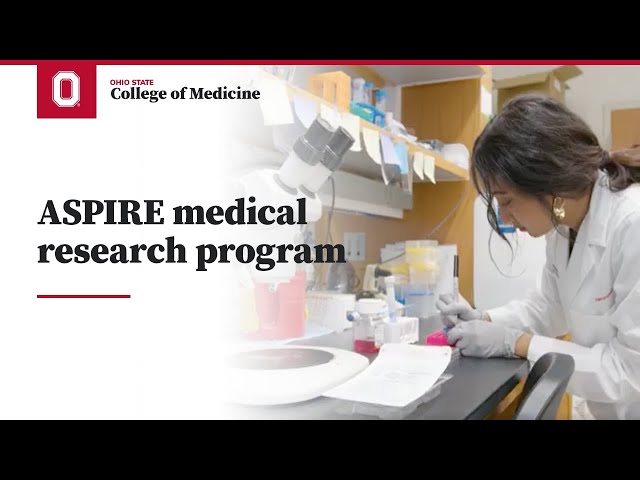
About the ASPIRE medical research program
The ASPIRE medical research program at The Ohio State University College of Medicine presents an exciting opportunity for undergraduate students at Ohio State to participate in a 10-week immersive research experience in a laboratory at one of America's top academic medical centers. The program is open to sophomores and juniors whose backgrounds have not afforded them the opportunity to engage in the health sciences.