For over a century, the explanation of how the brain and the body talk to the immune system has focused on the brain, relegating the spinal cord to the role of messenger carrying signals up to the brain and back down again. New findings by a team of researchers at The Ohio State University College of Medicine show that there’s more behind what influences immune function throughout the body than just the brain responding to the messages.
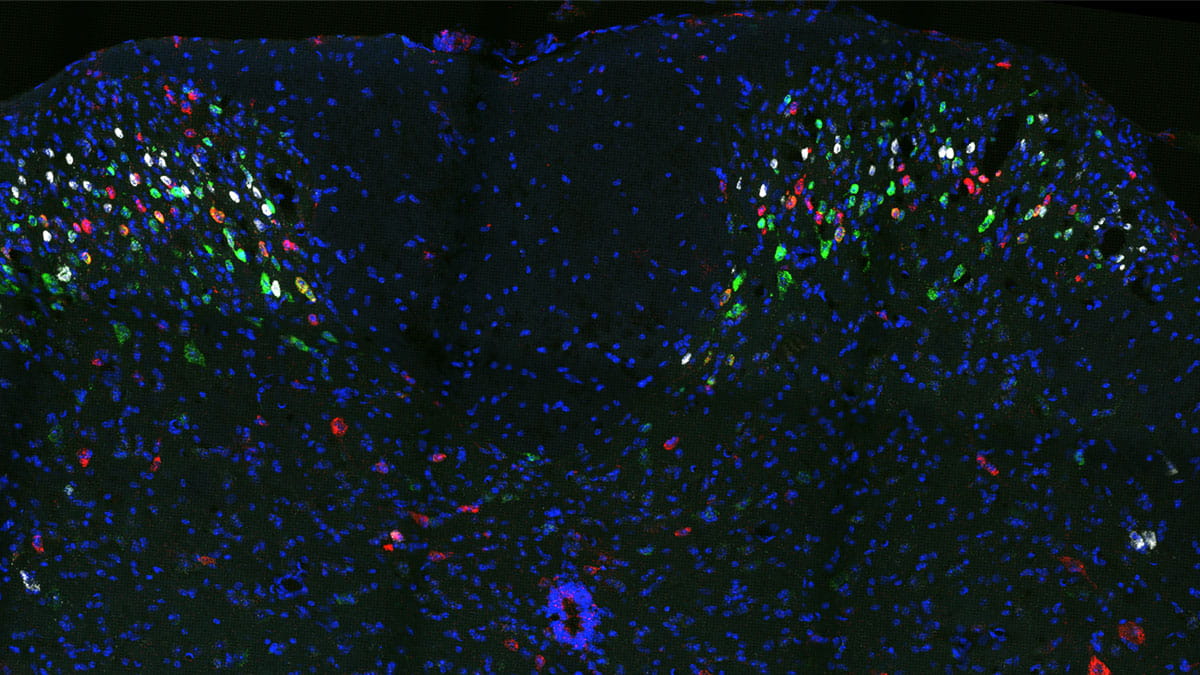
Phillip Popovich, PhD, Qin Ma, PhD, Eugene Oltz, PhD, Andrea Tedeschi, PhD, and their team have uncovered an unrecognized population of spinal cord immune synergy encoding neurons that are activated by systemic inflammation, suggesting the existence of a novel spinal cord–immune communication network. This builds on their previous work that proved that a spinal cord injury permanently damages the immune system, a phenomenon known as spinal cord injury-induced immune deficiency syndrome.
A $ 1.2 million grant from the W.M. Keck Foundation gives them the opportunity to challenge the traditional view of the brain as the primary nervous system regulator of immunity. Their project, “Unlocking the Spinal-Immune Axis: Foundational Mapping and Computational Modeling for a New Paradigm in Neuroimmunology,” will investigate how the spinal cord helps detect infection and coordinate the body's immune response, and will determine if the spinal cord is running its own dedicated circuit as a proven cause-and-effect relationship that senses infection and dispatches instructions to the immune system directly, without waiting on the brain at all.
The long-term implications of their findings could be significant, especially for people with spinal cord injuries, because:
- Immune suppression is already a severe problem but also is in other neurological conditions since spinal cord signaling is disrupted in most neurological diseases.
- The ability to build a road map toward bioelectronic medicine, which allows for the treatment of immune disease by precisely tuning spinal circuits rather than relying solely on broad-spectrum drugs with system-wide side effects, will be life-changing.
- It’s time to map how the immune system works when it is healthy and not damaged or weakened, using the same spinal cord knowledge and expertise but focusing it on the completely new area of neuroimmunology.
- The three stages of the project will include building a detailed 3D and molecular map of exactly which spinal neurons respond to an immune challenge and where they send their signals. The map will be fed into a computational and AI model that predicts which of those neurons matter most. Researchers will use mice – directly turning those specific neurons “on” or “off” in the lab mice to test whether they actually control immune and behavioral responses and not just correlate with them.
This is the second W.M. Keck Foundation Award given to Ohio State Wexner Medical Center researchers. Kristy Townsend, PhD, associate professor of Neurological Surgery at the College of Medicine, led the first award that studied brain and fat tissue connections, showing that unconventional hypotheses can lead to fundamental shifts in knowledge.