
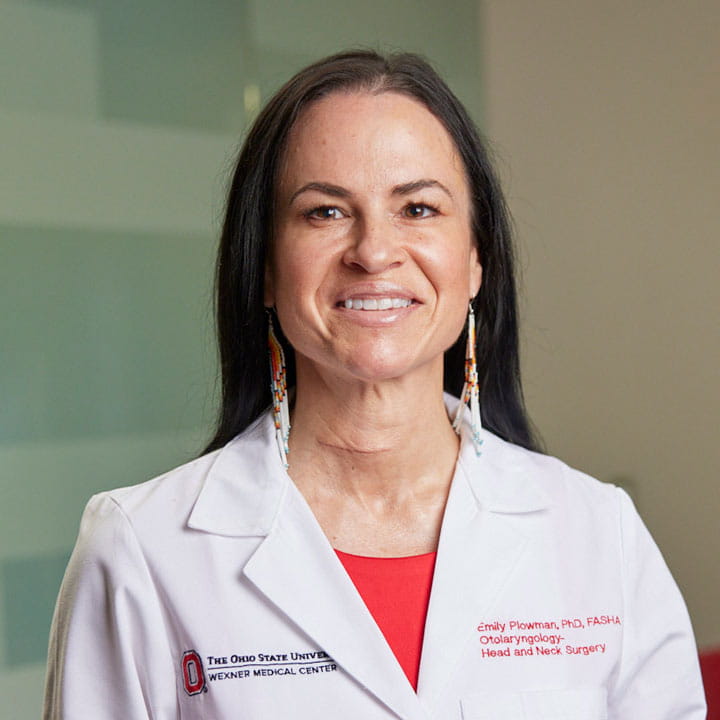
 The Aerodigestive Research Core (ARC) Laboratory, established in 2013 by Emily Plowman, PhD, CCC-SLP, professor in the Department of Otolaryngology – Head and Neck Surgery at The Ohio State University Wexner Medical Center, continues to advance the evaluation and treatment of aerodigestive tract disorders. The ARC Lab focuses on conditions affecting swallowing, breathing, and communication, with a mission to translate mechanistic insights into clinically actionable care pathways.
Historically centered on neuromuscular disease populations, the ARC Lab has broadened its scope to address aerodigestive dysfunction arising from cardiothoracic surgery, lung transplantation, congenital heart disease, and neurosurgical interventions. This expansion reflects both evolving clinical needs and the laboratory’s growing role as an interdisciplinary resource.
Improving outcomes in lung transplantation
Over the past year, Dr. Plowman and her team have partnered closely with the Heart and Lung Transplant Team at Ohio State, an active program that performs approximately 70 lung transplants annually as part of more than 600 total organ transplants. Key collaborators include Bryan Whitson, MD, PhD, director of the Division of Cardiac Surgery and interim co-director of the Heart and Vascular Center, and Kukbin Choi, MD, surgical director of the lung transplant and ECMO program.
“In a study of 232 adults undergoing lung transplantation, we recently identified that the presence of a baseline preoperative swallowing impairment was associated with a five-fold increased odds of one-year mortality,” Dr. Plowman explains. “These recent data have led to changes in the preoperative clinical workup in approved adults awaiting organs here at Ohio State.”
As a result, comprehensive clinical swallowing evaluations conducted by the ARC Lab at the Eye and Ear Institute are now part of the standard preoperative care pathway for lung transplant candidates. These assessments enable early identification of high-risk patients and provide targeted education prior to transplantation. “Ultimately, we hope that our added inclusion in the clinical care team will improve patient outcomes,” Dr. Plowman notes.
Advancing neurosurgical and cardiothoracic research
The ARC Lab has also expanded into neurosurgical populations. Dr. Plowman is collaborating with Stephanus Viljoen, MD, assistant clinical professor in the Department of Neurological Surgery, on a National Institute on Aging–funded R01 study investigating predictors of dysphagia following anterior cervical discectomy and fusion (ACDF).
In parallel, ongoing funded research includes a National Institute of Nursing Research R01 clinical trial examining independent dysphagia risk factors after cardiac surgery. This work aims to develop and validate an evidence-based aspiration risk prediction algorithm, similar to prior efforts in amyotrophic lateral sclerosis, with the goal of translating findings into an open-access, real-time dysphagia risk calculator to guide triaged clinical care.
National and multicenter collaborations
Beyond Ohio State, the ARC Lab maintains robust national collaborations. Dr. Plowman is working with Katherine Hutcheson, PhD, CCC-SLP (MD Anderson Cancer Center), and Nicole Rogus-Pulia, PhD, CCC-SLP (University of Wisconsin–Madison), on a National Cancer Institute–funded dissemination and implementation trial.
Additional projects include a Department of Defense–funded study examining the safety and potential efficacy of metformin, a commonly used type 2 diabetes medication, for treating bulbar dysfunction in individuals with C9orf72 amyotrophic lateral sclerosis, in partnership with Laura Ranum, PhD, and James Wymer, MD, FAAN, at the University of Florida.
“We have a group of passionate individuals – clinician scientists, PhD students, and postdoctoral fellows – whose mission is to improve our understanding of the mechanisms that contribute to swallowing disorders across a wide range of patient populations,” Dr. Plowman says. “The goal is to develop effective and targeted treatments.”
“I am exceptionally proud of the ARC Lab’s expanding clinical and scientific impact,” says Dr. Rocco. “Dr. Plowman’s work exemplifies how rigorous translational research can directly reshape patient care, most notably through changes to lung transplant evaluation that address modifiable risk factors and improve outcomes. The ARC Lab’s integration into cardiothoracic and neurosurgical care pathways reflects our department’s commitment to interdisciplinary collaboration, innovation, and improving the lives of patients with complex aerodigestive disorders.”