
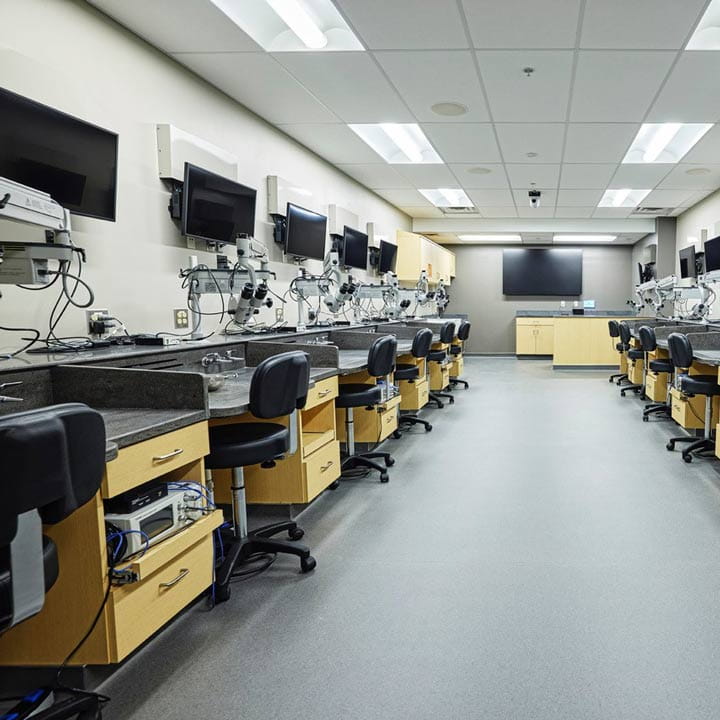
 The Department of Otolaryngology – Head and Neck Surgery at The Ohio State University Wexner Medical Center has strengthened its educational infrastructure with the March 2025 renovation of the Surgical Skills Laboratory, now serving as a centralized hub for hands-on training across all divisions. While the space was originally designed to enhance otologic and neurotologic education, it has already supported Rhinology training, with additional expansion planned as new curricula evolve. The revitalized lab provides a modern, high-fidelity environment where residents, fellows and medical students acquire the advanced technical skills essential to contemporary otolaryngologic practice.
To reinforce educational continuity and maximize the utility of the space, the Division of Otology, Neurotology, and Cranial Base Surgery launched structured monthly training sessions shortly after the renovation. “As part of our commitment to advancing resident education, we’ve introduced an engaging and dynamic monthly curriculum designed to immerse trainees in cutting-edge surgical techniques,” says Desi Schoo, MD, an assistant professor and a neurotologist, who is leading these initiatives. “Our hands-on sessions not only refine technical skills but also foster innovation and collaboration, empowering students to experience the excitement of real-world surgery in a state-of-the-art environment.”
The renovated lab features 12 fully equipped workstations, each with surgical microscopes, otologic drills, operative instruments and dedicated monitors capable of displaying the microscopic field. An expanded audiovisual system fully integrated with Cisco teleconferencing capabilities supports remote participation and interactive didactics, enhancing opportunities for collaboration with external faculty and industry partners.
The use of cadaveric temporal bone specimens, sourced through Ohio State’s Body Donation Program, provides unmatched anatomic fidelity. “Cadaver specimens are the highest-fidelity anatomic model that we have in surgery,” Dr. Schoo explains. “We get to use human ears and practice performing surgery just like we would in the operating room. It’s really a unique experience for surgical trainees.”
The lab supports education for learners at all levels. “It’s primarily used for educating residents, but also for fellow education and medical student education,” notes Robert Macielak, MD, an assistant professor and a neurotologist, who co-leads these initiatives. “The main goal is to provide a realistic experience similar to what they will face in the operating room when it pertains to ear surgery or otologic surgery.”
Industry partners regularly participate in training sessions, offering exposure to new surgical technologies and device demonstrations. Trainees have worked with emerging drill systems, cochlear and osseointegrated implant platforms, automated cochlear implant insertion devices, and bone cement materials used in ossicular reconstruction. “We’re trying to make it more than just exposure to the surgical dissections,” Dr. Schoo says. “We’re engaging with some of the equipment and devices that are available to us in the operating room as well.”
The lab’s versatility has drawn interest from divisions across the department. “There’s potential for expansion within our own department and utilization of that space within the other subspecialties. Not just neurosurgery, but facial plastic surgery, as well,” Dr. Macielak says. The facility has already supported Rhinology-specific educational sessions, and the department anticipates substantial growth in cross-disciplinary use.
Future plans include hosting regional and national temporal bone “boot camp” courses and expanding industry collaboration for research and device development. Dr. Schoo expresses his enthusiasm for these opportunities: “We’re immensely proud of the lab that we have and the work that’s been put into it. We’re very grateful for the effort and backing from the department to truly utilize it to its maximum potential.”
Dr. Macielak adds that ongoing philanthropic partnership is essential: “One of the main goals that Dr. Schoo and I have is to make sure we have a regular supply of specimens for the residents, and that does incur some cost and effort. If people feel inclined to donate to the department, they might consider donating specifically to this worthwhile endeavor.”
“I am extraordinarily excited about how this renovated Surgical Skills Lab is shaping the future of our educational mission,” says James Rocco, PhD, chair of the Department of Otolaryngology – Head and Neck Surgery.
“It has already strengthened surgical training in neurotology and lateral skull-base surgery while providing a versatile environment used by all our divisions, including emerging applications in Rhinology. The combination of high-fidelity anatomic models, cutting-edge technology and close collaboration with industry partners offers a training experience that few programs nationwide can match. This investment ensures that our trainees develop the skill, confidence, and technical mastery required for excellence in the operating room. The Surgical Skills Lab stands as a testament to our commitment to innovation, comprehensive education and maintaining Ohio State’s place as a premier destination for advanced surgical training in all areas of Otolaryngology – Head and Neck Surgery.”