
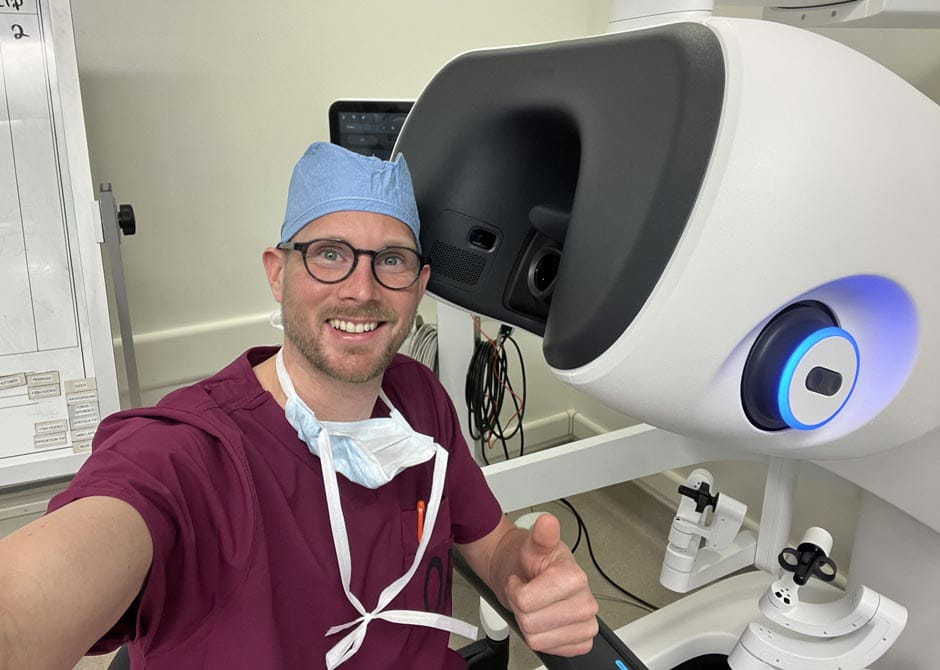
 The Division of Thoracic Surgery continues to advance the field of minimally invasive surgery, being among the first to utilize force feedback technology in robotic-assisted thoracic surgery, a breakthrough that promises to make surgery safer and more precise.
“Robotic surgery has always relied on visual cues to guide tissue handling, but the lack of tangible sensation has been a limitation,” says Peter Kneuertz, MD, associate clinical professor of Surgery in the division. “This is especially the case in thoracic procedures, where tissues are delicate. With the new da Vinci 5 system, surgeons can now measure and control the force exerted at the instrument tips, allowing for objectively gentler operations.”
A recently published multicenter study led by Dr. Kneuertz analyzed data from 444 thoracic procedures performed nationwide using force feedback instruments. The findings are compelling: Higher sensitivity settings on the force feedback system resulted in a significant 20% reduction in average instrument force, with the greatest benefit seen in lung resections and other complex thoracic surgeries. Retraction instruments, such as the Cadiere and fenestrated bipolar forceps, experienced the highest forces, but force feedback technology enabled surgeons to limit peak force and reduce tissue trauma.
“This technology is a giant step forward in the field of robotics,” Dr. Kneuertz says. “It’s like having lane assist in a car – it helps prevent excessive force and supports safer, more confident surgery. We think the technology may be especially helpful for thoracic surgical trainees who are still learning the operation. Also, our study shows that we can operate more gently, and we’re now working to correlate these improvements with patient outcomes.”
The team’s ongoing prospective study will look at more than 250 patients and further evaluate how force feedback technology impacts recovery, complication rates and overall patient experience.
“We’re proud to be one of the first centers in the world to lead this research in thoracic surgery,” Dr. Kneuertz says. “Our goal is to continue to improve outcomes and move the needle forward for our patients.”
The initiative is part of a broader collaboration with Intuitive Surgical and builds on the Food and Drug Administration Investigational Device Exemption trial led by Robert Merritt, MD, director of the Division of Thoracic Surgery.