ACHIEVE
Designing prototypes for a grant application

The Research User Experience and Design (RUED) core within College of Medicine Research Information Technology empowers faculty and clinician researchers to create digital products that improve clinical outcomes for patients, families and caregivers. We employ human-centered design strategies to ensure the finished product works for the people using it.
Partnering with principal investigators to rigorously scope target objectives, operational bottlenecks, and translational criteria.
Mapping observational investigator workflows to isolate hidden behavioral edge cases and technical constraints.
Converting complex scientific logic into high-yield, intuitive digital schematics and clinical-grade interface prototypes.
Guiding engineering teams throughout the build phase to ensure technical implementation strictly adheres to clinical intent and usability specs.
Measuring post-deployment adoption, operational accuracy, and cognitive load using objective usability metrics.

RUED involves potential users from the start of its design process. By employing sophisticated interview and testing techniques, we can pinpoint what people expect from a system and provide suggestions for how to make it better.

Before a single line of code is written, RUED seeks feedback on its designs. By creating prototypes that look and feel like using a real website or app, we can test them with people and make changes early on in the process, when it's quick and not costly to do so.
RIT works with research teams to identify operational bottlenecks, investigator constraints, and the core goals a solution needs to support. This early discovery helps clarify priorities, define functional requirements, and establish a focused scope before development begins. Learn more about User Requirements Gathering.
Featured project: ACHIEVE
RIT conducts formative and summative usability testing to assess system performance, user adoption, and cognitive load. These evaluations help identify usability issues, measure how weak a system supports intended tasks, and validate that digital tools can be used accurately and efficiently in clinical. laboratory, and research environment. Learn more about Usability Assessments and Qualitative Assessment.
Featured project: ACHIEVE
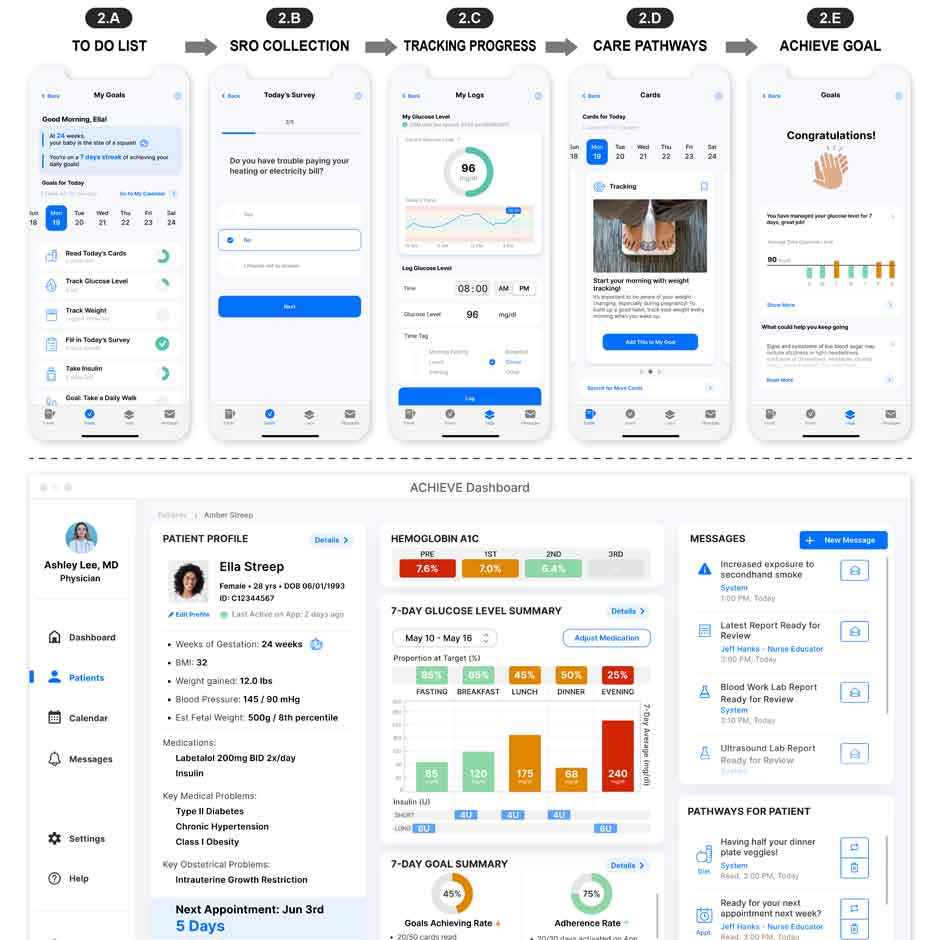
RIT works with research teams to create interactive system schematics, interface prototypes, and workflow models before full development begins. These prototypes help teams explore technical feasibility, refine how a solution should work, communicate the proposed approach, and strengthen grant applications with a clearer vision of a final system. Learn more about Rapid Prototyping.
Featured project: ACHIEVE
Robert Strouse
Director – Digital User Experience
Maya Jenkins
Senior User Experience Specialist
May Mallah zadeh
User Experience Designer
Lauren Phelps
Research Infrastructure Project Management Consultant
Yiting Wang
Senior User Experience Specialist