
What is Paper to Plastic?
Many research studies still rely on paper forms to collect information. Before that information can be analyzed, research teams may need to manually review, enter, and validate the data, a process that takes time and can introduce transcription errors.
Paper to Plastic helps automate that process by converting information from paper-based forms into structured digital data. RIT developed the system to extract information from scanned or photographed forms and map it into REDCap, where researchers can review, validate, and use the data for analysis.

How Paper to Plastic Works
Paper forms are scanned or photographed, information is extracted and mapped to the appropriate fields, and the resulting data is sent to REDCap for review and analysis. Validation steps help identify information that may require additional researcher review.
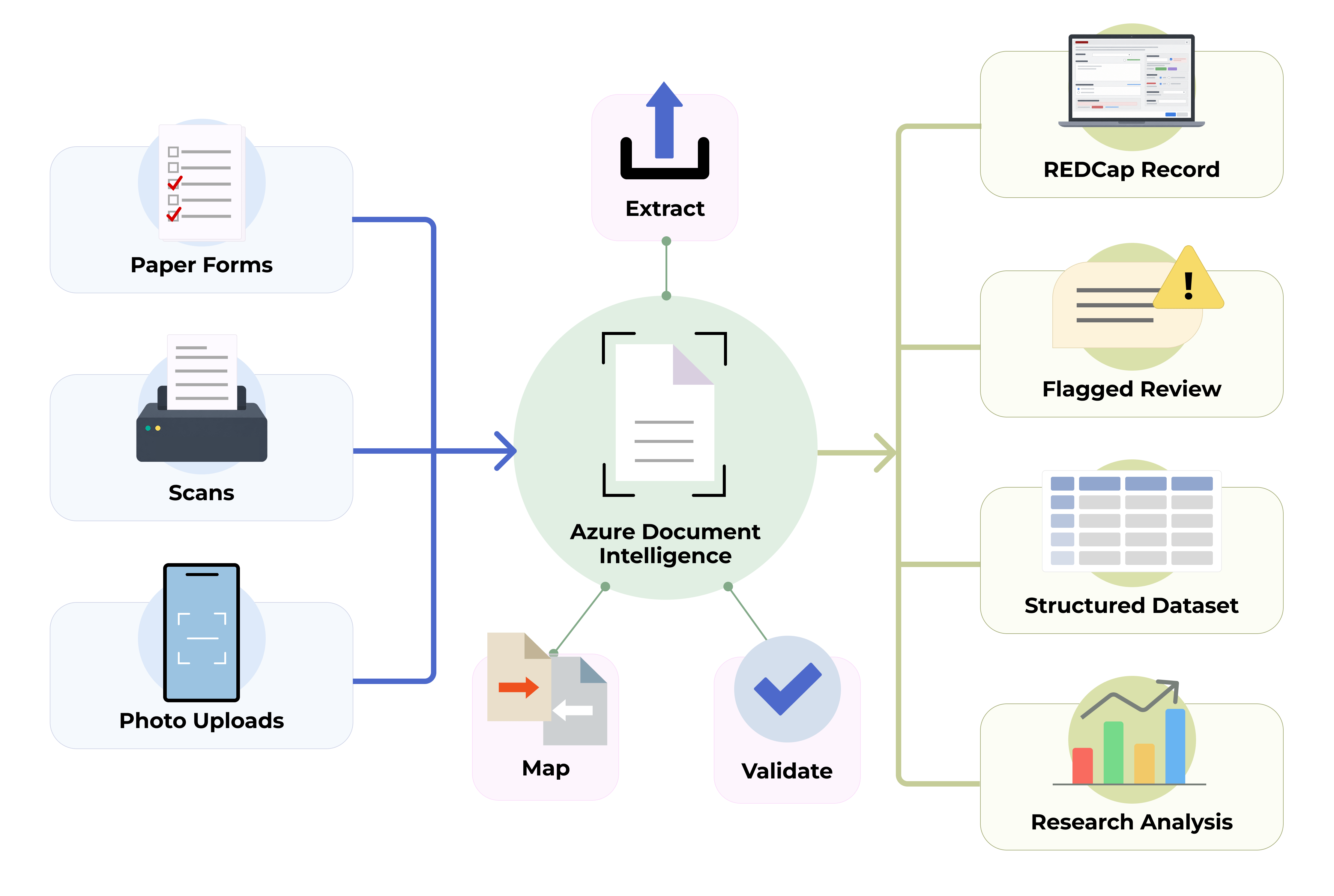
RIT’s Approach to Paper to Plastic
RIT designed Paper to Plastic as a repeatable, scalable pipeline that integrates document processing with existing research data systems. The focus was on ensuring accuracy, reducing manual effort, and creating a workflow that could be reused across studies with minimal customization.

Automating Data Extraction from Paper Forms
Paper to Plastic uses trained document models to identify and extract structured data from standardized forms. These models are configured to recognize fields, interpret handwritten or printed inputs, and map extracted values to predefined data structures. This approach reduces the need for manual transcription while maintaining consistency across datasets.

Integrating with REDCap
Extracted data is automatically routed into REDCap, where it can be reviewed, validated, and used for analysis. By connecting directly to REDCap, the system fits into existing research workflows without requiring teams to adopt new data management platforms. This integration supports HIPAA- and S4-compliant data handling while reducing the risk associated with manual data transfer.

Ensuring Data Quality and Validation
RIT incorporated validation steps into the pipeline to support data accuracy. Extracted values can be flagged for review when confidence is low or when inputs fall outside expected ranges. This allows research teams to focus manual effort where it is needed while maintaining overall data quality.

Building a Reusable Processing Pipeline
The system is designed as a reusable infrastructure that can be adapted to different form types and study requirements. RIT established patterns for model training, field mapping, and validation that reduce setup time for new use cases. This approach enables teams to extend the pipeline to additional studies without rebuilding the system from scratch.
Capabilities Brought Together
RIT brought together expertise from multiple teams to develop Paper to Plastic, combining technologies and capabilities to streamline research data processing.
Access to Paper to Plastic
Paper to Plastic serves as a reusable infrastructure for digitizing paper-based research workflows across OSUMC. RIT continues to expand its capabilities by refining document models and supporting new form types based on researcher needs, enabling more efficient and reliable data capture across clinical and research settings.