
What is LifeScale?
Clinical and translational research increasingly depends on integrating large, complex datasets. However, clinical, operational, and non-traditional data sources are often siloed, inconsistently structured, and difficult to access together. Researchers may need to build custom pipelines to prepare and connect these data, slowing analysis and limiting their ability to work efficiently with multimodal information. A unified, secure environment is needed to support data integration, scalable analysis, and reuse without requiring teams to repeatedly rebuild infrastructure.
LifeScale is a secure, cloud-based research environment designed to support clinical and translational research. Co-sponsored by The Ohio State University Clinical and Translational Science Institute and the College of Medicine, LifeScale integrates multimodal datasets and provides scalable computing resources within a governed environment. The platform brings together structured data models, including Caboodle and OMOP, with unstructured clinical data and non-traditional sources such as telemetry, alarms, and registry data. By combining data integration, computing resources, controlled access, and governance in one environment, LifeScale enables researchers to analyze complex datasets without relying on separate custom infrastructure or unnecessary data movement.
Learn more about LifeScale at go.osu.edu/lifescale.
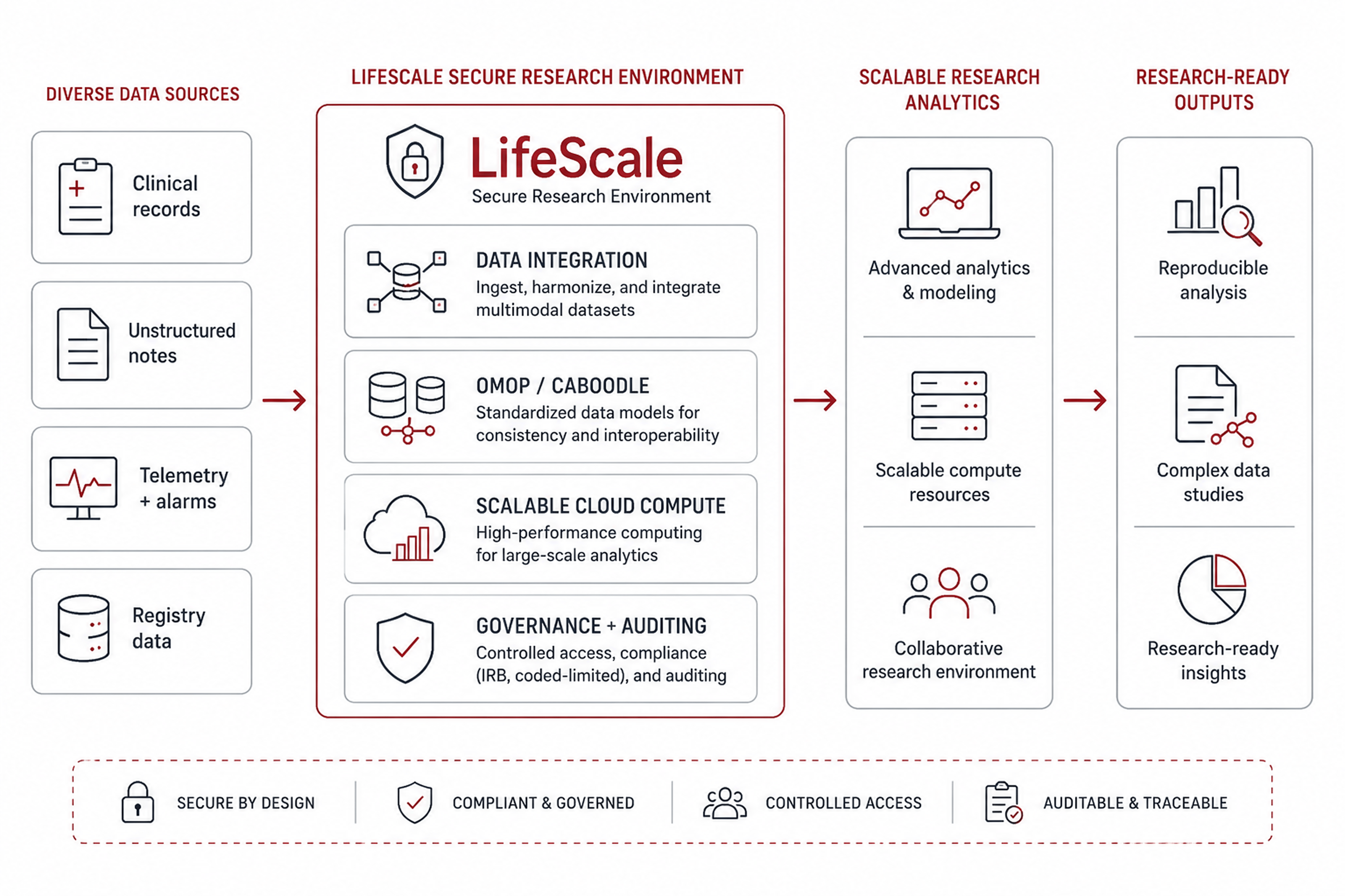
Transforming diverse health data into secure, scalable, and research-ready insights.
RIT's Approach to LifeScale
RIT designed LifeScale as a unified infrastructure that supports data ingestion, integration, and analysis within a secure and governed environment. The focus was on enabling access to diverse data sources while maintaining compliance and reducing the need for custom pipelines.

Integrating Multi-Source Signals
Rose is designed to ingest and evaluate inputs from multiple sources, including patient-reported data, system-generated events, and external integrations. By considering these signals into a unified framework, ROSE enables more informed decision-making and coordinated responses that would otherwise require multiple disconnected systems.
Providing Secure, Scalable Compute
The platform includes cloud-based computing resources that enable researchers to run analyses on large datasets without managing local infrastructure. This supports high-performance analytics while ensuring that sensitive data remains within a controlled environment aligned with institutional requirements.
SupportingStandardized Data Models
LifeScale incorporates data using the OMOP Common Data Model for research that needs to be generalized or reproducible irrespective of EHR vendor, as well as Caboodle for supporting Epic-specific analyses.
Reducing the Need for Custom Pipelines
By integrating data ingestion, storage, and compute into a single system, LifeScale reduces the need for study-specific data pipelines. Researchers can access prepared datasets and supported environments directly, allowing them to focus on analysis rather than infrastructure setup.
Enabling Governed, Compliant Data Access
By integrating data ingestion, storage, and compute into a single system, LifeScale reduces the need for study-specific data pipelines. Researchers can access prepared datasets and supported environments directly, allowing them to focus on analysis rather than infrastructure setup.
Access to LifeScale
LifeScale serves as a foundational research infrastructure across OSUMC, enabling secure access to integrated datasets and scalable analytics. RIT continues to expand its capabilities by supporting new data sources, refining integration patterns, and working with research teams to enable more complex and data-intensive studies.