
About AI Solution Engineering & Deployment
RIT helps research teams and partners turn AI ideas and strategy roadmaps into working solutions. We provide the technical planning, design, engineering, testing, deployment, and operational handoff needed to build AI tools that are secure, modular, usable, and sustainable.
Our team supports projects from early requirements through production readiness, with attention to privacy, security, governance, human oversight, and long-term maintainability.
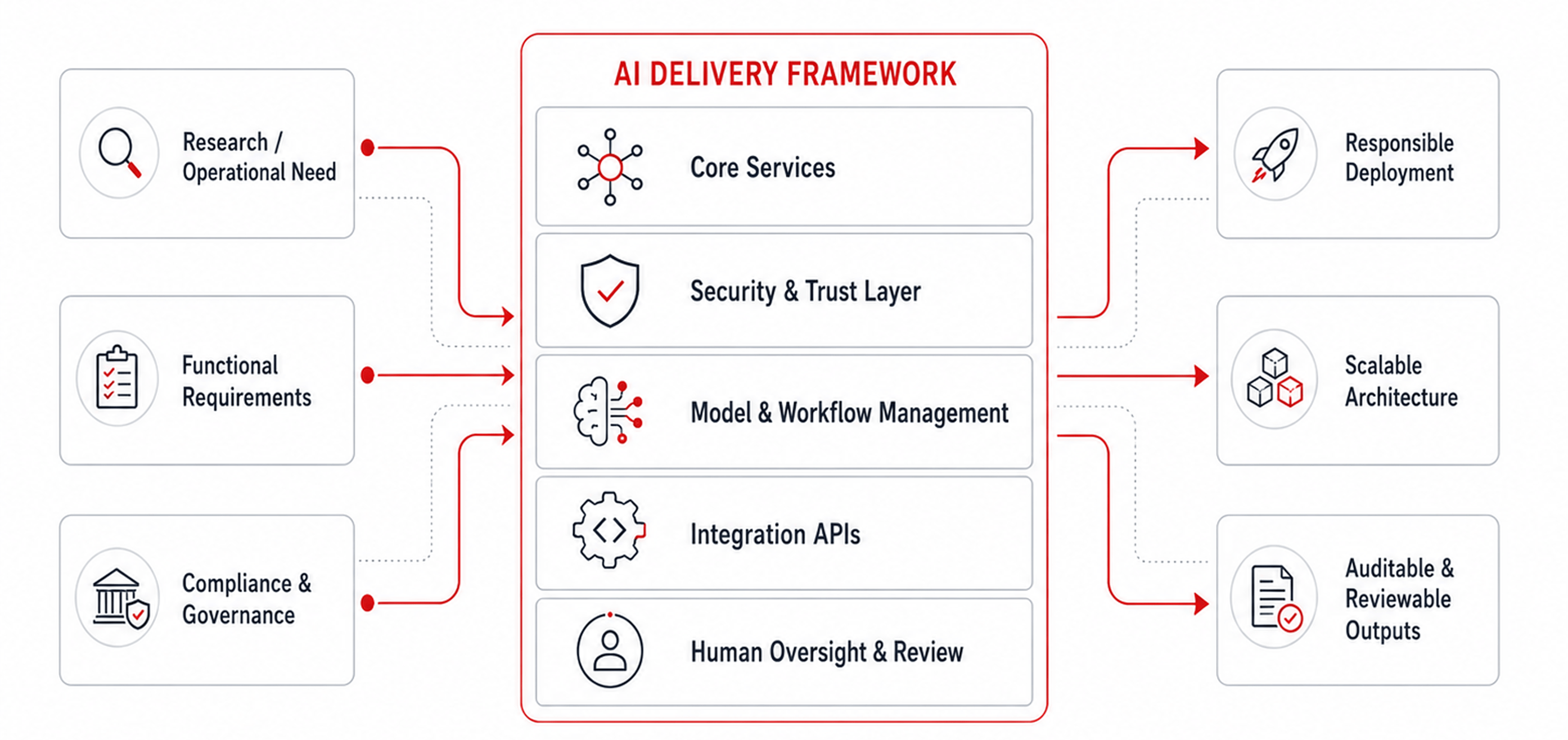 RIT uses a structured delivery framework to move AI solutions from defined needs to responsible deployment.
How RIT Build and Deploy AI Solutions

Define the problem before building
RIT works with teams to clarify the research, operational, or business need before selecting a tool, model, or platform. We define requirements, user needs, success measures, data dependancies, security considerations, and workflow expectations so the solution built around the real problem needs to solve.

Build secure, testable prototypes
RIT develops AI-enables prototypes and proof-of-concept tools that can be tested, validated, and refined with real users. This may include chatbots, digital assistants, retrieval-aumented generation systems, natural language processing workflows, or AI-supported data extraction tools.

Prepare for responsible deployment
RIT supports the transition from prototype to operational use by addressing security review. privacy requirements, documentation, training, runbacks, monitoring needs, and long-term support planning. We help teams move toward deployment in secure cloud, research enclave, hybrid, or approved institutional environments.
What RIT Can Build

Generative AI and RAG solutions
RIT can build retrieval-augmented generation systems that use approved source documents or knowledge bases to generate grounded, source-supported responses. These tools can help user research, summarize, and navigate complex information while reducing the risk of unsupported outputs.

Agentic AI and workflow support
RIT can design AI agents and guided workflows that assist with complex tasks such as document review, data extraction, case note processing, clinical documentation support, or administrative workflow automation. These tools are designed to support human decision-making rather than replace it.

Natural language processing tools
RIT can use natural language processing to help conversation unstructured text, such as policies, reports, forms, case motes, or clinical documentation, into searchable and usable data. This can support information retrieval, classification, summarization, extraction, and analysis.

Human-centered and inspectable AI tools
RIT designs AI tools with human oversight built into workflow. We support source attribution, clear disclaimers, review points, escalation pathways, and user-centered interfaces so teams can understand, verify, and responsibly act on AI-supported outputs.

Flexible and secure deployment
RIT supports deployment planning across secure and approved environments, including Azure, AWS, secure research enclaves, hybrid infrastructure, and institutional platforms. Our approach emphasizes portability, compliance, documentation, and alignment with existing with existing systems.