
The Center for Translational Research in Acute Care and Trauma Surgery (CTRACT) is a multidisciplinary research center at The Ohio State University Wexner Medical Center dedicated to accelerating scientific discoveries into clinical impact for acute care surgery, critical care, burn and trauma patients.
Our team includes clinicians, basic scientists, data scientists and collaborators from engineering, biostatistics, bioinformatics, public health and industry who work together to reduce morbidity and mortality, improve patient outcomes and drive innovation in critical illness, emergency surgery, burn injury and trauma care.
Research at CTRACT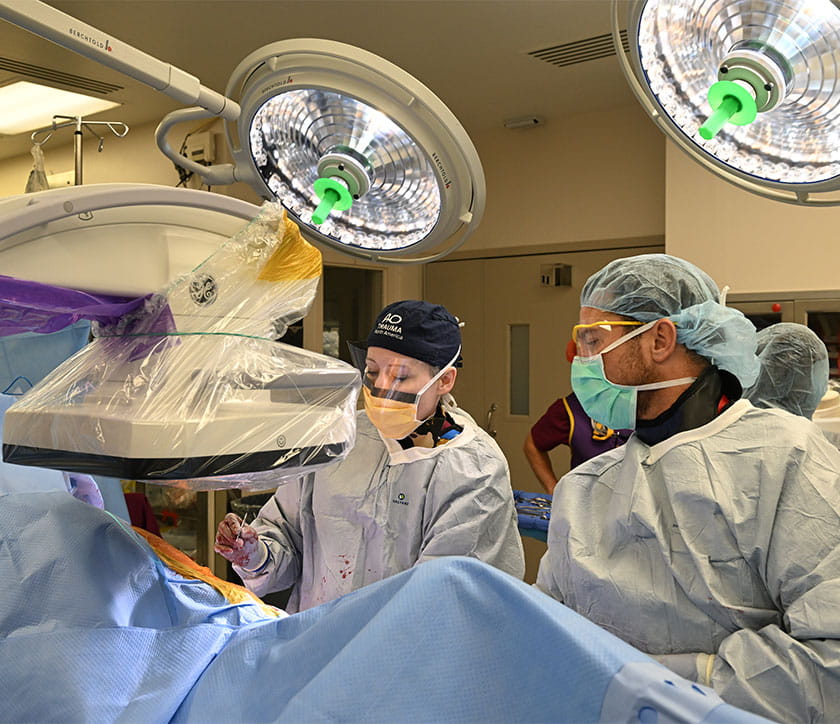
The Center for Translational Research in Acute Care and Trauma Surgery (CTRACT) unites surgeons, intensive care providers, scientists and trainees to advance discovery across acute care surgery, trauma and critical illness.
Our mission is to accelerate the translation of research findings:
- From National Institutes of Health (NIH)-funded mechanistic studies and multidisciplinary scientific projects
- To industry-sponsored clinical trials and health services research
- Into improved patient outcomes
Through strong industry partnerships and active leadership in multi-institutional trials, CTRACT serves as a bridge between scientific innovation and bedside application.
By integrating laboratory science, clinical investigation and real-time outcomes data, we provide the infrastructure and expertise needed to transform ideas into evidence-based care for patients with life-threatening surgical and critical care conditions.
How CTRACT supports different aspects of research, clinical trials and industry relationships
CTRACT’s dedicated research infrastructure, study expertise and strong industry partnerships, including those with medical device and pharmaceutical companies, can be used to advance projects of any size.
- Industry-sponsored studies: Identify, initiate and manage clinical trials in collaboration with industry partners to test new therapeutics, devices and diagnostics in acute care surgery, trauma, burn and critical care.
- Regulatory and contractual support: Provide oversight and resources for Institutional Review Board (IRB) submissions, contract negotiations, regulatory compliance and reporting to streamline study setup and execution.
- Translational innovation pathways: Bridge investigator-initiated discovery with industry-backed development to facilitate early‐phase trials and commercialization efforts.
More about our research and resources
-
- Comprehensive clinical databases: To ensure data integrity and accessibility, maintain and curate multiple high-quality datasets, including sepsis cohorts, surgical intensive care units (SICU), acute care surgery (ACS), trauma and prisoner outcomes.
- Observational and predictive analytics: Use real-world data to explore epidemiologic trends, outcome determinants, risk stratification and support generation of hypotheses for interventional studies.
- Real-time monitoring and feedback: Develop infrastructure to analyze patient data in real or near-real time, enabling rapid-cycle learning and quality improvement in trauma and critical care settings.
-
- National Institutes of Health (NIH)-funded mechanisms research: Conduct mechanistic work supported by NIH grants (e.g., R35, K08), studying underlying biological, immunologic or physiologic processes in critical illness and injury, including inflammation, sepsis and epigenetics.
- Projects funded by surgical societies and nonprofits: Engage in collaborative investigations and smaller-scale high-impact studies that are funded by foundations and surgical societies, such as the Surgical Infection Society, American College of Surgeons and the Central Surgical Society.
- Cross-disciplinary innovation: Bring together experts from surgery, critical care, immunology, bioinformatics, engineering and other disciplines to integrate omics, imaging and computational modeling for translational breakthroughs.
-
CTRACT partners also gain access to state-of-the-art laboratory resources, including:
- Genetic and epigenetic editing platforms, such as CRISPR/Cas9 and other gene-silencing/modulation techniques;
- Live-cell imaging systems for tracking real-time cellular responses to stress, infection and therapeutic interventions;
- Molecular biology platforms for RNA/DNA sequencing, epigenetic profiling and transcriptomic analysis;
- Animal modeling facilities for translational studies in sepsis, trauma, acute care surgery and critical illness; and
- Cell culture and immune assays to investigate host-pathogen interactions, inflammation and recovery mechanisms.
-
To support these opportunities, CTRACT supports:
- Fellowship and student training: Develop education programs, including our NIH T32 (ARTIST) training program in translational research, a structured research training program for ACS/Critical Care fellows, the summer research fellowship for medical students, and other structured research tracks for fellows and junior faculty.
- Visiting scholar and seminar series embedded into ACS education conferences: Host quarterly research lectures and invite external leaders to share evolving science, promote collaboration and expose our team to diverse perspectives.
- Medical student summer research fellowship: Sponsor medical students to perform a summer research program with mentors in trauma, critical care and burn surgery. Structured introduction to research lecture series.
Early-career development: Provide mentorship, pilot funding and opportunities for junior investigators (e.g., former fellows now holding K08s) to secure NIH funding, lead projects, publish and succeed in all competitive funding environments.
The CTRACT team
-
-
- Adara McCarty, clinical research specialist
- Kylie Wentworth, clinical research coordinator
- Nick Pisanelli, clinical research assistant
-
- Manjula Karpurapu, PhD
- Ryan Harkless, researcher
- Clark Ingram, MD
Support CTRACT: Invest in innovation. Transform patient care.
Your donations drive innovation, mentorship and the advancement of science that saves lives.
Your gifts help us:
- Expand translational research in acute care and trauma surgery
- Accelerate discoveries from the laboratory to the bedside to improve outcomes for patients with trauma, surgical emergencies and critical illnesses and expand access to lifesaving therapies
- Build sustainable programs that integrate science, education and clinical excellence
- Support, train and mentor promising investigators and trainees in surgery and critical care
- Develop more industry partnerships and build collaborative infrastructure